How to stop procrastinating when you keep putting off what matters
The report has been “almost done” since September. You know exactly what the next step is, and every time you sit down to take it, something else becomes urgent: the inbox, the laundry, one more video. Most advice treats procrastination as a time problem and hands you a planner. For a lot of people the planner doesn't help, because what they keep putting off is the feeling the task brings up.

What procrastination looks like
- You start the day with a plan and end it having done everything except the one thing that mattered.
- You leave it to the last minute and call it working well under pressure.
- When the important task comes up, you find five small, easy ones to do first. Psychologists call this task avoidance.
- You can't get yourself to start anything, even things you used to want to do.
- You feel guilty all day about the thing you didn't do, and the guilt makes tomorrow harder.
Why you put things off
Research describes procrastination mainly as a way of managing how you feel in the moment. Tasks that bring up anxiety, boredom, self-doubt or overwhelm get pushed back, and the relief of pushing them back teaches you to do it again (Sirois and Pychyl, 2013). Repetition makes it stronger: the more often a path in the brain is used, the more it becomes the default (Hebb, 1949).
Why the things you care about most are the ones you put off longest
The tasks we put off longest usually carry the most weight: a project that says something about whether you're good enough, a message that could change a relationship, a decision you can't undo. The more a task matters, the more there is to feel about it, and the easier it becomes to wait for a day when you'll feel ready.
The story that keeps the same week repeating
Procrastination always comes with a reasonable story: I'll do it when I have a clear afternoon, I need more information first, I work better under pressure. Because the story sounds sensible, nobody questions it, including you, so the same week repeats with a different date. Willpower alone rarely wins against it (why willpower fails).
How to stop procrastinating: a method you can start today
- Write the next physical action, small enough for ten minutes. “Open the document and write a bad first paragraph” works better than “finish the report”.
- Think about starting it and write down what shows up, exactly as it sounds in your head, even if it's only “I don't want to”.
- Name the feeling under it: fear of doing it badly, anger at having to do it, sadness about what it means. Putting a feeling into words lowers its intensity (Lieberman et al., 2007), which is why naming it makes starting easier. If you can't name it, sit with the sensation for a minute.
- Give the feeling somewhere to go. This is the core of Victoria Colombato's exercise Anxiety is usually just the lid: write “When I feel [feeling], I [action]” for each feeling (when afraid, shake out your body; when angry, exhale hard; when foggy, give yourself one small task), read it out loud and do the one that fits.
- Do ten minutes of the task. Then decide whether to keep going.
- At night, write what you avoided, what you felt and what you told yourself. Read it back once a week.
What you see after a few weeks
After a few weeks of notes, the pattern shows up. It's usually the same kind of task, often the one where you could be judged, with the same feeling and the same sentence attached. Once you can see that, you can work on what sits under the task instead of fighting the task every morning (why habits don't stick without self-awareness). If the fear is of doing it badly, perfectionism may be the circle you're in; if you keep replaying the decision, look at overthinking; and if it shows up in every part of your life, start with feeling stuck.
Where Pausa comes in
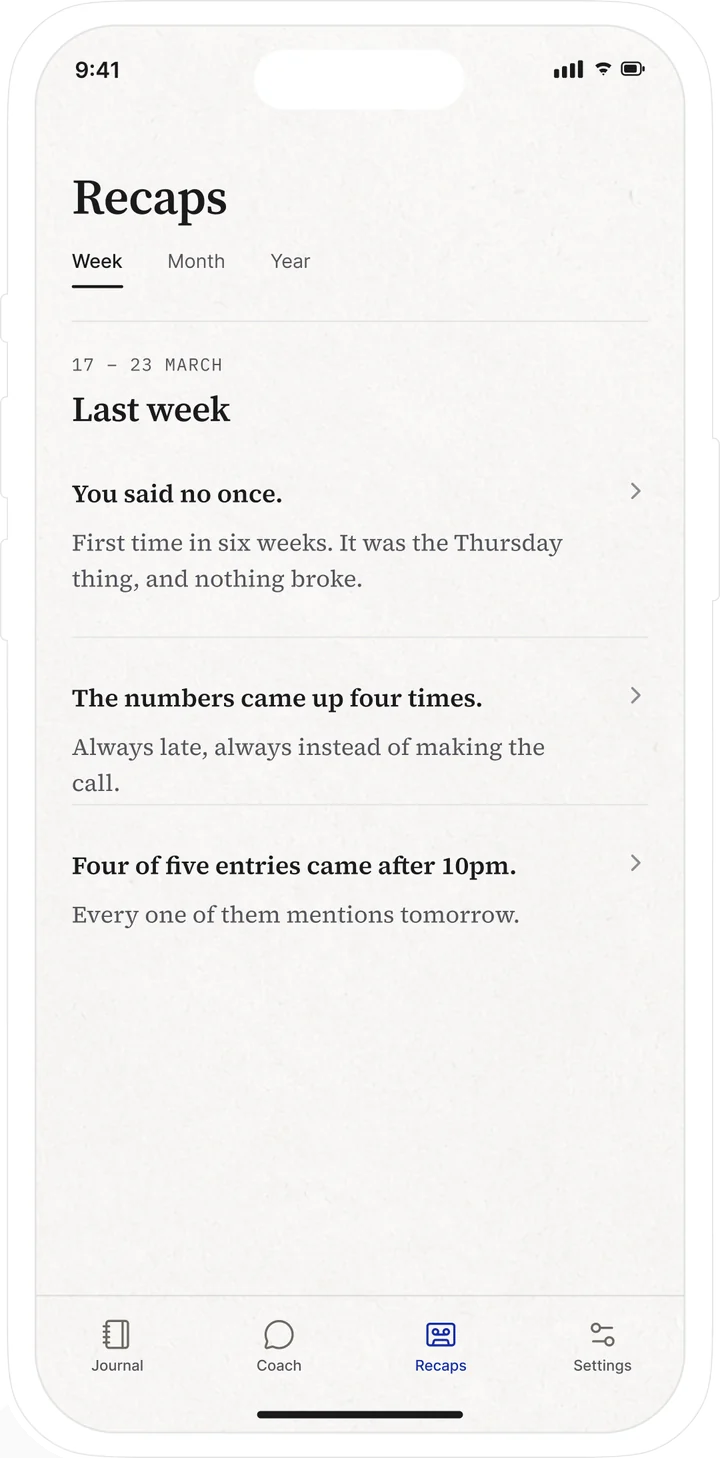
Pausa is the journal that pushes back so you can move forward. When you catch yourself putting it off again, you tell Pausa what's really going on, by text, voice or WhatsApp, in the moment. It asks the question you've been avoiding, and because it remembers what you wrote last week and last month, it notices when “I'll start on Monday” shows up for the third week in a row and says so, plainly. Every Monday, the recap shows you what you kept putting off and what was under it, when you're calm enough to look. What you do with it stays your call. See how it works.
Frequently asked questions
Why do I procrastinate so much?
Usually because the task brings up a feeling you'd rather not have, like fear of getting it wrong or of being judged, and putting it off gives you relief right away. That relief teaches you to do it again, so the habit grows.
Why do I procrastinate even when I want to do something?
Wanting the result and wanting the process are different things. If starting brings up self-doubt or fear of getting it wrong, part of you avoids that feeling while another part still wants the outcome.
Is procrastination a sign of laziness?
Usually it isn't. People who procrastinate often feel guilty about the undone task all day. Research links procrastination to how people handle difficult feelings about a task.
Why can't I motivate myself to do anything?
Sometimes it's a long run of avoidance, where every put-off task adds weight to the next one. If it comes with a low mood that doesn't lift for weeks, trouble sleeping or losing interest in most things, talk to a doctor. Pausa is a journal and doesn't replace professional care.
What is task avoidance?
Task avoidance is putting off a specific task by doing other, easier ones. It feels productive, which is why it's hard to catch.
How do I stop procrastinating right now?
Pick the smallest next action, set ten minutes and start before you feel ready. Afterwards, write down what you felt, so you can see the pattern later.
Next time you catch yourself opening your inbox instead of the document, text Pausa instead.
- iPhone
- iPad
- Mac


