How to stop being a perfectionist when nothing you do feels good enough
The presentation was ready on Tuesday. You changed the font on Wednesday, rewrote the intro on Thursday and sent it at 11:58 on Friday night, still sure it wasn't good enough. Perfectionism means holding yourself to standards you can rarely meet and judging yourself hard every time you don't. It often passes for ambition, which is exactly why it's so hard to question.

What perfectionism looks like
- You redo things nobody asked you to redo.
- You don't start until you're sure you can do it well, so some things never start.
- Praise slides off in a minute and criticism stays for weeks.
- You think “I'm not good enough” right after doing something well.
- One small mistake colors the whole day.
- You'd rather not try than try and fail.
Why it's never good enough
Perfectionism usually protects you from something: being criticised, being found out, disappointing someone who matters. If the work is perfect, nobody can judge it, and since perfect never arrives, the bar moves every time you reach it. Every mistake you avoid brings a moment of relief, and that relief teaches you to keep checking. The more often a pattern runs, the more it becomes the default (Hebb, 1949).
That's also why perfectionism and putting things off travel together. Starting means risking a result that isn't good enough, so waiting feels safer (how to stop procrastinating).
Fear of failure and the fear of making a mistake
Fear of failure is usually fear of what a failure would say about you. A missed deadline turns into proof that you're not capable, and a typo turns into proof that you're careless. When the stakes feel that high, your mind spends its energy on the fear instead of the task. In one study, students who wrote about their worries for ten minutes before a high-stakes exam scored better, and the students who tended to worry most gained the most (Ramirez and Beilock, 2011). Getting the fear out of your head and onto a page frees up room for the work.
The job you never applied for: an exercise
This exercise comes from Victoria Colombato's The job you never applied for. You describe your perfectionism as a job you hold, which makes it impersonal enough to look at without shame. Here's how it might read, and then you write your own:
- Job title: Head of Never Being Criticised.
- Reports to: Anyone who might judge the work, including people who will never see it.
- Start date: Often the first time getting it right earned you something, like attention, approval or calm at home.
- Responsibilities: Checking everything three times, predicting every objection, fixing what nobody noticed.
- Compensation: A few minutes of relief. Rarely pride.
- Key performance indicators: Zero mistakes, zero criticism.
- Performance review: Daily, run by you, with no positive feedback.
- What happens if you fail: Everyone finds out you're not good enough.
Then answer two questions: why did you apply for this role, and why are you the perfect fit? The answers usually show a strategy that made sense once, which is easier to change than a personality.
How to stop being a perfectionist: a method
- Before you start, write in one sentence what “good enough” looks like for this task, and stop when you reach it.
- Write the worst realistic outcome if it isn't perfect, and what you would do if it happened.
- Before a high-stakes moment, spend ten minutes writing about the worry.
- This week, send one thing at 80% on purpose, and write down what happened.
- After a mistake, write the exact sentence your head says, then check it against the facts. Arguing with it through positive statements tends to backfire (Wood et al., 2009), while checking it against what happened gives you something real to work with.
- Keep a record of what you feared and what actually happened. Read it back after a month.
When “I'm not good enough” is the sentence underneath
For a lot of people, “I'm not good enough” sits under more than perfectionism. It's the same sentence under saying yes to everything (people pleasing), under not starting, and under pulling back right when things go well (why you self-sabotage when things go well). A belief like that shows up in many different situations, so it looks like many different problems (limiting beliefs and self-sabotage). If you recognize it in several parts of your life, start with feeling stuck in life.
Where Pausa comes in
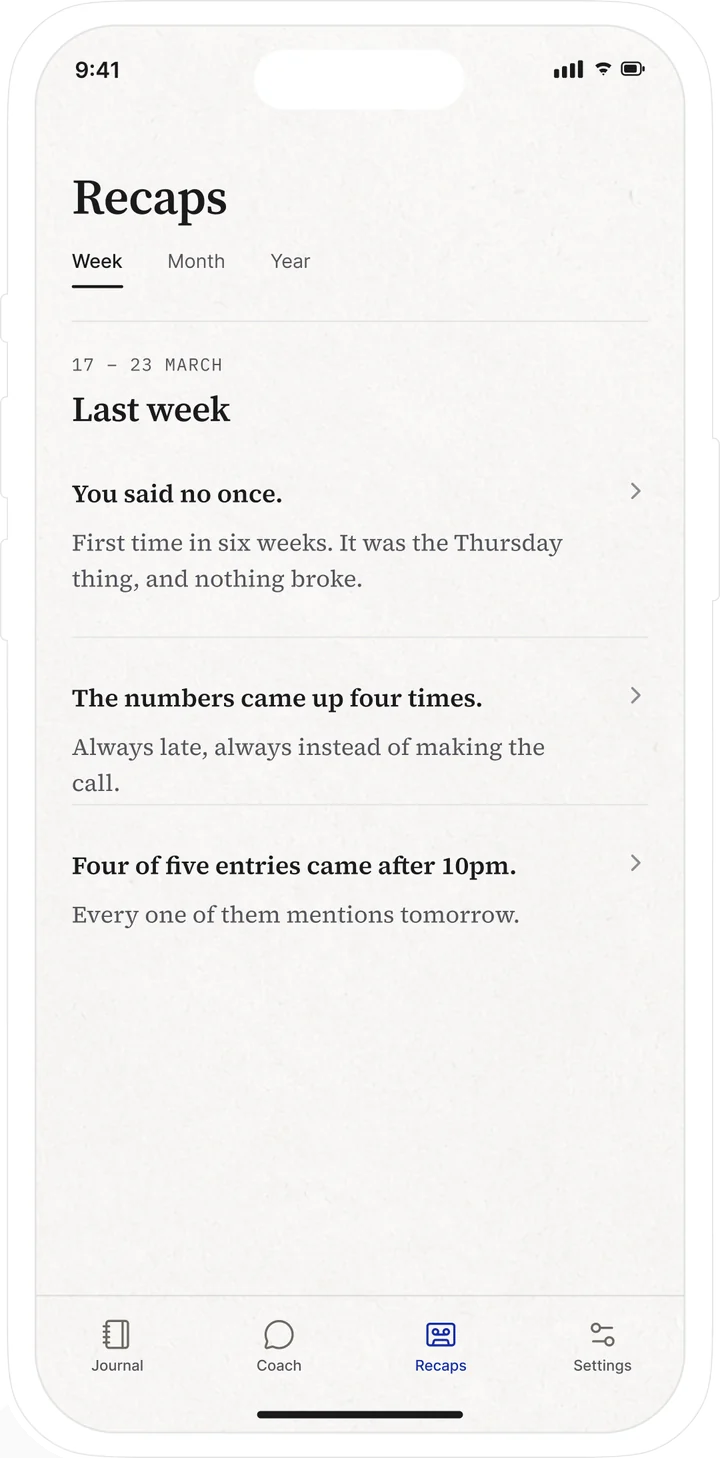
Pausa is the journal that pushes back so you can move forward. When you're about to rewrite something for the third time, you tell Pausa what's going on, by text, voice or WhatsApp. It asks what you're afraid will happen if you send it as it is. It remembers what you wrote last time, so when the same fear shows up before a different deadline, it shows you, plainly, along with what actually happened after. Every Monday, the recap puts what you feared that week next to what came true, when you're calm enough to look. Pausa won't tell you you're amazing. It shows you the evidence, and what you do with it stays your call. See how it works.
Frequently asked questions
What causes perfectionism?
Usually a mix of temperament and experiences where getting things right earned approval or kept criticism away. The mind keeps the rule long after the situation that created it has changed.
Is perfectionism a good thing?
High standards can help. Perfectionism becomes a problem when nothing you do feels like enough, mistakes feel like verdicts on who you are and you avoid things you might not do perfectly.
How do I get over the fear of failure?
Lower the stakes on purpose. Try small things you might fail at, write down what you feared and what happened, and let the record show you that most failures are smaller than the fear.
Why do I feel like I'm never good enough?
Often because the standard moves every time you reach it, so you never get to feel done. If the feeling comes with a low mood that lasts for weeks, talk to a doctor or a therapist. Pausa is a journal and doesn't replace professional care.
Is perfectionism related to procrastination?
Often. When the result has to be perfect, starting feels risky, so you wait. See how to stop procrastinating.
Next time you're about to redo something for the third time, text Pausa instead.
- iPhone
- iPad
- Mac


