How to stop overthinking when your head runs the same loop
It's 1:40 a.m. and you're on the fourth replay of something you said at lunch. You've decided twice what they meant by their reply, and twice you've changed your mind. Overthinking feels like working on the problem. Most of the time the same thoughts go around without getting anywhere, and the decision you actually need to make keeps waiting until morning, and then until next week.

What overthinking looks like
- You replay a conversation from three days ago and still rewrite your side of it.
- You've made a pros and cons list for the same decision more than once, and it said the same thing every time.
- “What if” thoughts take over at night: what if they're upset, what if it goes wrong, what if you picked the wrong option.
- You second guess a message you already sent, then reread the whole conversation looking for proof.
- You ask five people what they think and feel less sure after every answer.
- You can't make a decision until it feels certain, and it never does.
Why your head keeps going over the same thing
Psychologists call this kind of repetitive thinking rumination, and research separates it into two kinds. Brooding means going over what went wrong and why it happened to you, and it predicts a lower mood over time. Reflection means looking at a problem in order to understand it or do something about it, and it tends to help (Treynor, Gonzalez and Nolen-Hoeksema, 2003). Overthinking is usually brooding that feels like reflection, which is why it's so convincing from the inside.
It also gets stronger with use. The more often a line of thought runs, the more it becomes the default path your mind takes (Hebb, 1949), so the loop you ran last night starts faster tonight.
What the loop is protecting you from
A loop that keeps coming back is usually doing a job. As long as you're still thinking, you haven't had to decide, and you haven't had to feel what sits under the thought: fear of getting it wrong, of being disliked, of losing something you care about. Thinking feels safer than feeling, so your mind keeps producing new angles on the same question. Asking friends or ChatGPT one more time feeds the same loop, because every answer gives you something new to go over (why ChatGPT always agrees with you).
Writing it down changes that. In one study, students who wrote about their worries for ten minutes before a high-stakes exam performed better than those who didn't, and the effect was strongest for the students who tended to worry most (Ramirez and Beilock, 2011). On paper, a thought becomes something you can look at instead of something you keep carrying.
How to stop overthinking: a method for the next loop
- Write the thought down exactly as it sounds in your head. “What if they think I was rude” looks different on a page than it does at 1 a.m.
- Ask one question: is there something I can do about this in the next 24 hours? If there is, write the action and when you'll do it. If there isn't, the loop is doing something else.
- Name the feeling under it: fear, anger, sadness or shame. Putting a feeling into words lowers its intensity (Lieberman et al., 2007). If you can't name it, notice where you feel it in your body.
- Give the feeling somewhere to go. This comes from Victoria Colombato's lid exercise: write “When I feel [feeling], I [action]” for each feeling (when afraid, shake out your body; when angry, exhale hard; when foggy, give yourself one small task), read it out loud and do the one that fits.
- If the loop is about a decision, set a deadline: “I'll decide by Thursday at 6 with what I know now.” Most decisions don't get better after the third replay (why you keep overthinking the same decision).
- Once a week, read back what you wrote. Mark the topics that came back, the feeling under them and the time of day.
How to stop overthinking at night
Night is when the loop gets loudest, because nothing else is competing for your attention. Before bed, spend ten minutes writing everything that's going round in your head, then end with one line: “This can wait until [time] tomorrow.” Keep a notebook or a voice recorder next to the bed, so a thought that shows up at 2 a.m. goes onto the page instead of back into the loop. If you've been sleeping badly for weeks, talk to a doctor.
How to stop overthinking in a relationship
Overthinking in a relationship usually looks like decoding: the tone of a text, how long a reply took, what a short answer meant. The loop is trying to get certainty out of someone else's behavior, and it rarely can. Write the facts on one side (what was said, and when) and the story you're telling yourself on the other. If the same worry keeps coming back about the same person, it may be a question you need to ask them instead of yourself (how to have that conversation), or a sign you're weighing something bigger (should I break up?).
How to stop second guessing yourself
Second guessing means making a decision and then reopening it. Keep a short record of the decisions you make and how they turned out. Most people find their first call was fine far more often than they remember, and a record is harder to argue with than reassurance. If decisions pile up and every one feels heavy, decision fatigue may be part of it.
Where Pausa comes in: a journal for overthinking that answers back
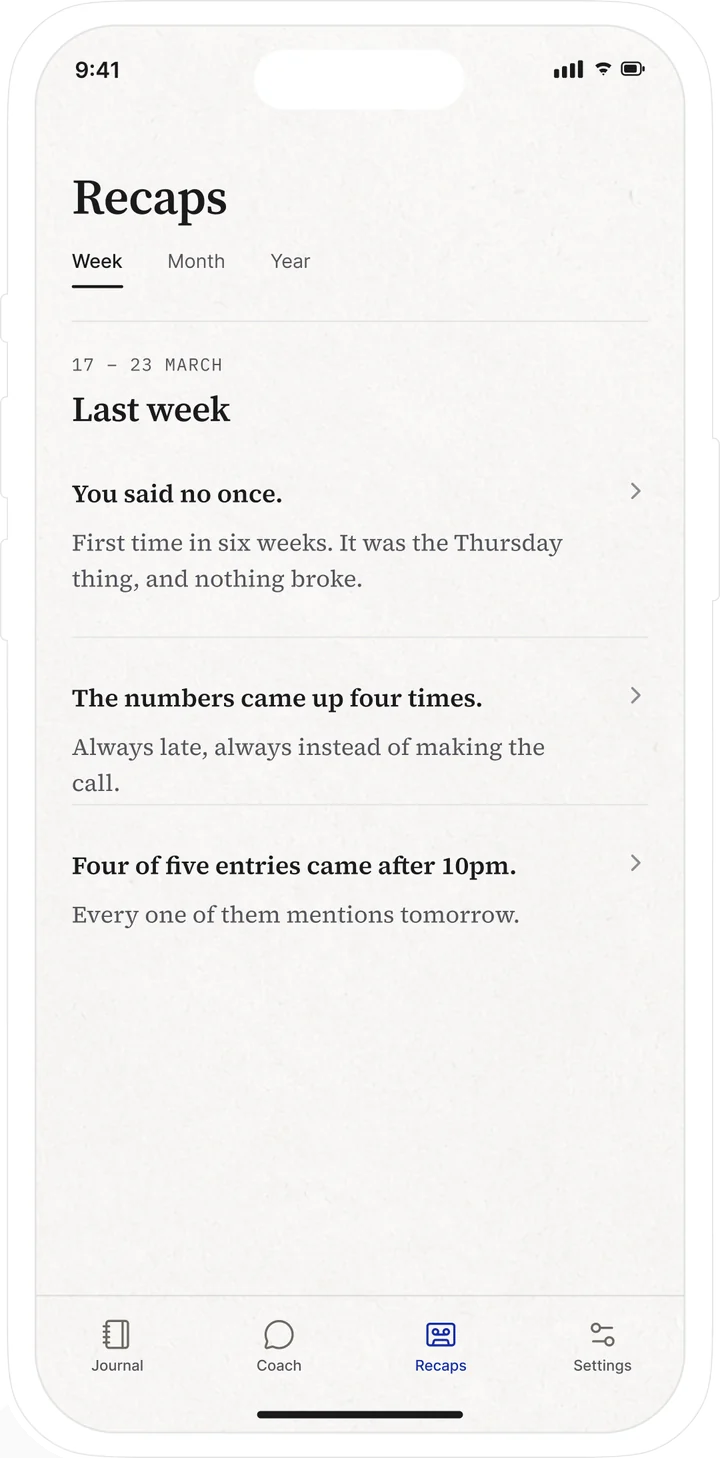
A blank journal can easily become one more place to loop. Pausa is the journal that pushes back so you can move forward. When the loop starts, at 1 a.m. or in the middle of a meeting, you tell Pausa what's going round in your head, by text, voice or WhatsApp. It asks whether you're trying to solve something or going over it again, and what you're afraid will happen. It remembers what you wrote last week, so when the same worry comes back with a new detail, it shows you the earlier entries and says so, plainly. Every Monday, the recap shows you what you kept replaying and what you decided, when you're calm enough to look. The decision stays yours. See how it works.
If the loop shows up as putting things off, read how to stop procrastinating. If it's one of many places you feel stuck, start with feeling stuck in life.
Frequently asked questions
Why do I overthink everything?
Usually because thinking feels like control. When a decision or a relationship feels risky, going over it again postpones the moment you have to act or feel what's under it, and every repetition makes the habit stronger.
How do I stop ruminating?
Rumination means going over the same problem without moving toward an answer. Write the thought down, ask whether there's an action you can take in the next day, and if there isn't, name the feeling under it. If rumination comes with a low mood that lasts for weeks, talk to a doctor or a therapist.
What are “what if” thoughts?
They're thoughts about things that might go wrong. They feel like preparation and rarely prepare you for anything. Write each one down and, next to it, what you would actually do if it happened.
I overthink everything. Is that normal?
Overthinking is very common. It becomes a problem when it keeps you from deciding, sleeping or enjoying things. If it comes with constant worry, panic or a low mood, talk to a professional. Pausa is a journal and doesn't replace professional care.
Why can't I make a decision?
Often because every option has a cost and the loop is waiting for one that doesn't. Set a deadline, decide with what you know and write down why, so you have your reasons when the doubt comes back.
Does journaling help with overthinking?
It can, especially when the writing has a direction: naming the feeling and deciding the next step. Writing in circles on paper is still a loop (why journaling often doesn't work).
Next time you catch yourself on the fourth replay, text Pausa instead.
- iPhone
- iPad
- Mac


