Stuck in life? How to get unstuck and stop running in circles
You put real effort into changing something, and a few months later you're standing in the same place. Same kind of job, same kind of argument, same plan you were going to start on Monday. Most people who feel stuck have already tried plenty of things. What usually stays out of sight is the circle itself.

What running in circles looks like
- You catch yourself asking “how did I end up here again?” about a situation you were sure you had left behind.
- You know something has to change, but when someone asks what, you don't have an answer.
- You've talked it through so many times that your friends can finish your sentences, and everyone tells you you're right.
- You've been about to do something about it for months.
- Every new start, a new job, a new relationship, a new plan, begins well and ends somewhere familiar.
Why you keep ending up in the same place
A pattern that keeps coming back is usually doing a job for you, even when it costs you. Saying yes keeps conflict away, thinking it through one more time postpones a decision that feels risky, and staying busy keeps a harder question out of view. As long as the pattern keeps doing that job, willpower alone rarely beats it, and every repetition makes it stronger: the more often a path in the brain is used, the more it becomes the default (Hebb, 1949).
The second reason is that the circle is hard to see from inside. Every time it starts again it looks like a new situation, with new people and new reasons, so you treat it as a new problem. It only becomes visible when you line up what happened across weeks and months, and almost nobody keeps that record.
The third reason is the feedback you get. Friends love you and take your side. ChatGPT tends to agree with whatever you bring it (why that happens). Most self-care apps are designed to make you feel better after each session. Comfort has its place, but when everyone agrees with your version of the story, nothing in it has to change.
Writing helps here when it has a direction. Research on expressive writing, going back to James Pennebaker's studies in the 1980s, found that putting what's really going on into words helps people make sense of it, and the effect is larger when the writing is guided toward something specific instead of left open.
An exercise to see your circle today
This comes from You don't have 20 different problems. It takes about 30 minutes and works on paper or on your phone.
- Draw four columns.
- In the first column, list every tool, practice, app, book, course, therapy or program you've tried in the last five years. It takes longer than you expect, and it can feel a little uncomfortable.
- In the second column, mark each one as “fix” or “explore”, depending on why you started it.
- In the third column, write what each one was supposed to fix or explore.
- In the fourth column, finish the sentence “I wanted to fix or explore this because…” and write what you hoped would change.
Now count. First, how many fixes against how many explorations. Most people find far more fixes, which says a lot about how they see themselves. Then count the distinct answers in the fourth column, not the number of rows. The long list usually comes down to two or three beliefs written in many different ways. Those are the circle. That's good news, because two or three beliefs are far easier to look at honestly than twenty separate problems.
How to break the cycle after you've seen it
- Write down what happened the same day, plainly. A voice note counts.
- After two to four weeks, read it back and mark what repeats: the situation, what you told yourself and what you did.
- Name the job the pattern is doing for you. What would you have to feel or face if you stopped?
- Choose one small action this week that goes against the pattern, small enough that you will actually do it.
- Write down what happened when you tried, and what you told yourself afterwards.
How to change your mindset when you keep ending up in the same place
The most reliable way to change your mindset is to catch the thought you have at the exact moment you repeat the pattern. Write it down as it sounds, then check it against what actually happened. A belief you can see on paper can be questioned, while one that stays in your head keeps running the show.
How to break bad habits that keep coming back
A habit that keeps returning is usually meeting a need, like relief, comfort or a break from a feeling. Before you try to remove it, write down what happens right before it and what you get from it. Then choose a replacement that meets the same need in a way you can live with, and track for two weeks whether it holds (why habits don't stick without self-awareness).
How to stop self sabotaging
Self-sabotage often shows up right when things start going well: you skip the follow-up, start the argument or drop the plan a week before it pays off. It usually protects you from a risk that success would bring, like being seen, being judged or losing something familiar. Write down the last three times it happened and what you were about to get. Once you see what you were protecting yourself from, you can decide whether you still need that protection (why you self-sabotage when things go well).
How Pausa helps you stop running in circles
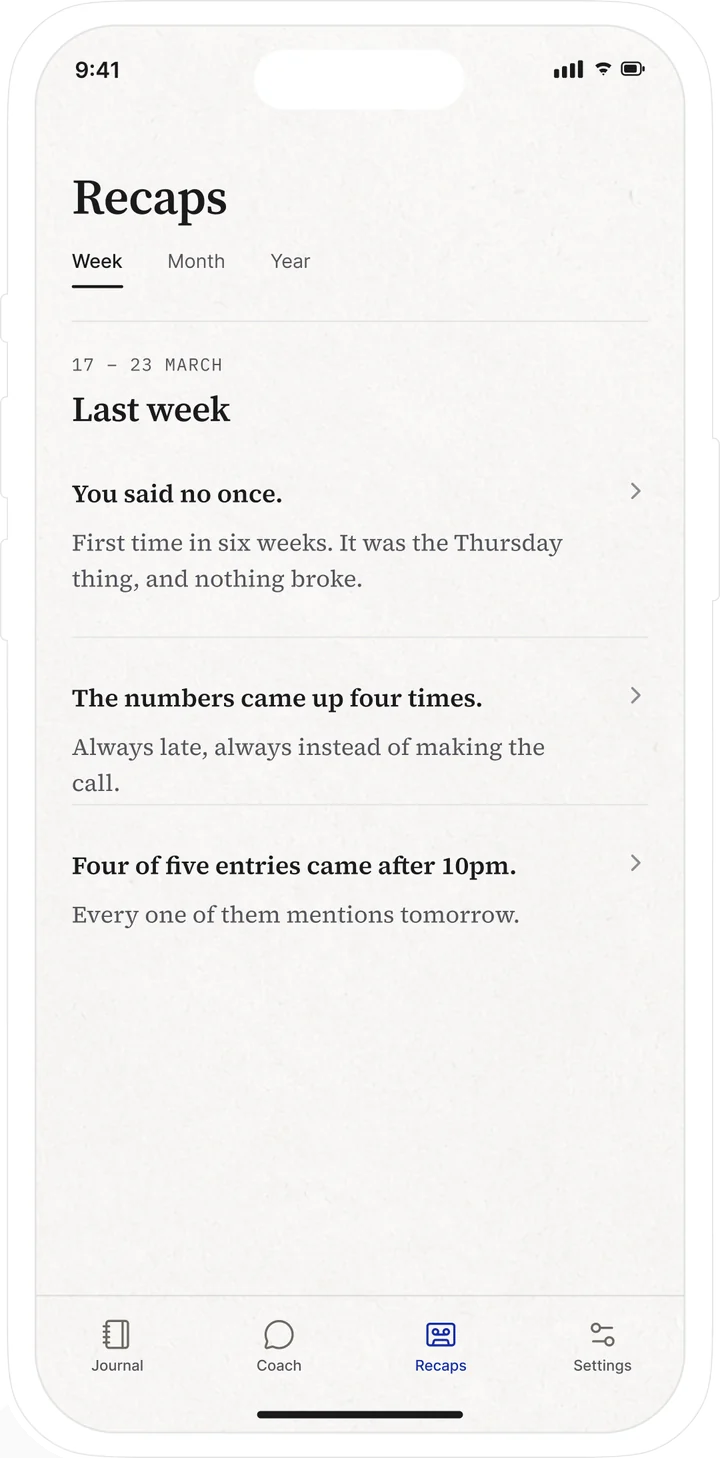
Pausa is the journal that pushes back so you can move forward. When you hear yourself asking “how did I end up here again?”, you tell Pausa what really happened, by text, voice or WhatsApp, including the parts you'd edit out for your friends. It asks the question you've been avoiding. It remembers what you told it last week and last month, so when you start telling yourself the same story again it says so, plainly. Every Monday, the recap shows you what kept coming back, when you're calm enough to look at it, and helps you see the step you've been avoiding. Taking it stays your call. See how it works.
Where are you going in circles?
- In your head, putting things off or replaying the same thoughts: procrastination and overthinking
- With your energy, saying yes to everything and resenting it later: people pleasing
- With someone, not together and not apart: situationship
Frequently asked questions
Why do I feel stuck in life even though I'm trying hard?
Because effort is usually going into the symptoms. If the same belief sits under every attempt, each new plan runs into it and you end up where you started. Seeing that belief is the step that changes what effort can do.
How do I break a cycle I keep repeating?
Write down what happens each time, read it back after a few weeks to find what repeats, name what the pattern protects you from, and test one small action against it. Then keep a record of what happens.
Why do I keep making the same mistakes?
Usually because each situation looks new from inside, so the lesson never connects to the last time. A written record across months is what lets you recognize the circle while you're in it.
Is feeling stuck a sign of something more serious?
Feeling stuck is common. If it comes with a low mood that doesn't lift, trouble sleeping or losing interest in most things, talk to a doctor or a therapist. Pausa is a journal and doesn't replace professional care.
Next time you hear yourself say “how did I end up here again?”, text Pausa instead.
- iPhone
- iPad
- Mac


