How to stop being a people pleaser when yes comes out before you think
You said yes to helping with the move on Saturday, the extra project on Monday and the dinner you didn't want to go to on Thursday. Each one took two seconds to agree to and a whole evening to resent. People pleasing means putting other people's comfort ahead of your own needs so often that you stop noticing you're doing it. From the outside it looks like being kind and reliable. From the inside it feels like your energy goes to everything except what you actually want.

What people pleasing looks like
- You say yes before you've checked whether you want to.
- You know everyone's mood in the room before you know your own.
- You apologise first, even when it wasn't your fault, just to make the silence stop.
- You rehearse how to say no and hear yourself say “sure, no problem”.
- You feel guilty resting while someone else is busy.
- You give, then resent it, then feel guilty about the resentment.
Why you keep saying yes when you mean no
People pleasing usually started as a smart move. At some point, keeping other people happy kept you safe, loved or out of trouble, and the mind repeats what once worked. The more often a response is used, the more it becomes the default (Hebb, 1949). The pattern also keeps paying: you get praise, you avoid conflict, you feel needed. The cost (your time, your rest and what you wanted to do with them) arrives later and quietly, and it piles onto your mental load, so the pattern rarely gets questioned.
This is also why telling yourself “my needs matter” in the mirror tends not to work. In one study, repeating positive statements about yourself made people with low self-esteem feel worse (Wood et al., 2009). What helps more is seeing exactly when and why you say yes.
The job you never applied for: an exercise
This exercise comes from Victoria Colombato's The job you never applied for. The idea is to describe your people pleasing as if it were a job. Shame depends on seeing a pattern as a flaw in who you are, and a job description makes it impersonal enough to look at.
Write these fields:
- Job title. Victoria's own was “Emotional Stabilization Lead”.
- Reports to. Hers: anyone in the room, changing without notice.
- Start date. When did you start doing this? There was probably no onboarding.
- Responsibilities. Reading everyone's mood, spotting conflict early, absorbing friction, taking on more when nobody says who should.
- Compensation. Praise in proportion to output, and relationships that last as long as performance stays high.
- Key performance indicators. Zero conflict, nobody disappointed, no visible effort.
- Performance review. Continuous, with feedback only when you miss a target.
- What happens if you fail. What are you afraid would happen?
Then answer two questions: why did you apply for this role, and why are you the perfect fit? Most people find the role made a lot of sense when they took it on. Seeing it as a strategy that once protected you makes it much easier to decide whether you still want the job.
How to say no without a speech
- Buy time. Most yeses happen in the first two seconds, so make “Let me check and get back to you tomorrow” your default answer.
- Ask yourself one question: do I want to do this, or do I want to avoid how saying no will feel?
- Say no in one sentence: “I can't take this on this week.” A long explanation invites negotiation.
- Notice what you feel afterwards and write it down. Guilt usually peaks in the first hour and fades.
- Watch what happens. Most people take a no much better than the version in your head.
How to stop being a people pleaser: a method
- For one week, write down every yes and whether you meant it.
- Mark the ones you'd take back, and next to each one, what you were afraid would happen if you'd said no.
- Do the job description exercise above.
- Choose one low-stakes no for next week, like a meeting you don't need to attend or a favor you don't have time for.
- Keep a record of what you feared and what actually happened. After a few weeks, that record does more than any pep talk.
If most of your yeses happen at work, I hate my job covers the role you play there. If the pressure is about getting everything right, read about perfectionism.
People pleasing in relationships
In a relationship, people pleasing sounds like “I don't mind” when you do. You manage their mood before you've checked your own, you keep a list of topics to avoid that keeps getting longer, and you agree to keep the peace and then feel lonely in the same room. Your part, and the part you can change, is what you stop saying. If the same dynamic shows up with every partner, read about relationship patterns. If you've started asking whether you should stay, read should I break up?.
Where Pausa comes in
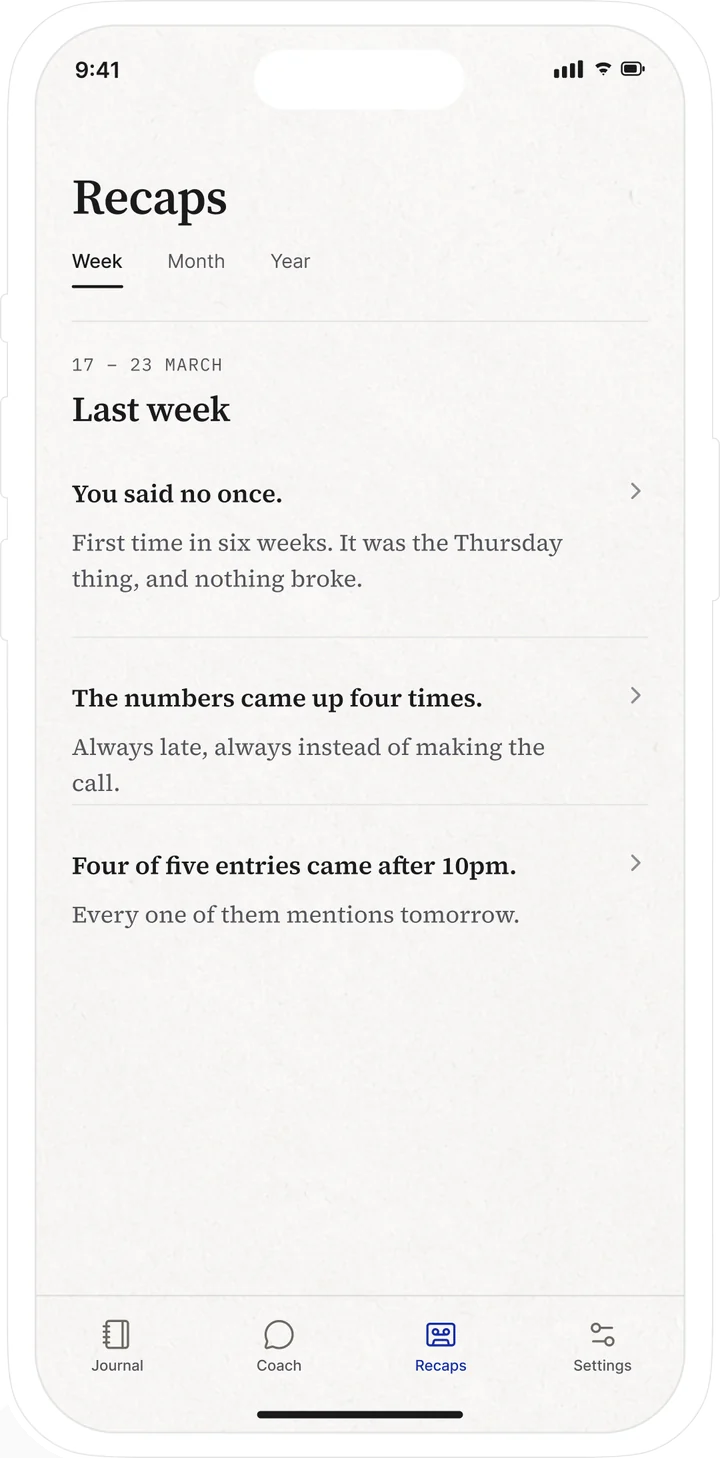
Pausa is the journal that pushes back so you can move forward. When you've just said yes and already regret it, you tell Pausa what happened, by text, voice or WhatsApp, including the parts you'd edit out for your friends. It asks what you were afraid would happen if you'd said no. It remembers what you told it, so when the same person gets the same yes for the third week in a row, it says so, plainly. Every Monday, the recap shows you where your energy went and who it went to, when you're calm enough to look. Pausa won't cheer you on or tell you to set boundaries. What you do with what you see stays your call. See how it works.
People pleasing often sits next to other circles. If you can't tell where yours starts, begin with feeling stuck in life.
Frequently asked questions
Why am I a people pleaser?
Usually because keeping others happy worked at some point. It kept conflict away, earned approval or made you feel safe, and your mind kept doing it long after you needed it.
Is people pleasing bad?
Being considerate is good. It becomes a problem when you say yes so often that your own needs disappear and resentment starts building up.
How do I say no without feeling guilty?
You probably won't at first. Guilt is what breaking an old rule feels like, and it fades with repetition. Say no in one sentence, then write down what actually happened.
I can't say no. Where do I start?
Start small: buy time before every answer and pick one low-stakes no this week. Practice on things that don't matter much before the ones that do.
What's the difference between being kind and people pleasing?
Kindness is something you'd choose again. People pleasing usually comes with dread before and resentment after.
Next time a yes is on its way out before you've thought about it, text Pausa instead.
- iPhone
- iPad
- Mac


