
Why Writing Your Goals Once a Year Almost Guarantees You’ll Forget Them
Jan 1, 2026
Yearly goals fade when ignored. Use daily, weekly, and monthly reviews, habit stacking, spaced repetition, and AI journaling to keep progress on track.

Most people abandon their yearly goals because they don’t revisit them. Writing down goals once and ignoring them leads to forgetfulness and failure. Here’s why this happens and how to fix it:
Your brain deprioritizes forgotten goals: Without regular reminders, mental clutter takes over, making long-term goals fade.
Life changes make static goals irrelevant: Unexpected events and shifting priorities require ongoing adjustments.
Consistency builds habits: Regular reviews help embed goals into your routine, reducing the mental effort needed to stay on track.
The solution? Create a system of daily, weekly, and monthly goal reviews. Use techniques like spaced repetition, habit stacking, and breaking goals into smaller milestones. Tools like AI journaling apps can simplify tracking and provide feedback, helping you stay focused.
Key takeaway: Revisit your goals often, track progress, and adjust as needed to turn resolutions into lasting achievements.
Quarterly Goals Review DIY Goalsetting System for Achieving Goals with Erin Condren, Kanban, Journal

Why Regular Goal Reviews Matter for Your Brain
Your brain isn’t built to remember goals you jot down once and then forget. The hippocampus - the part of the brain responsible for memory - decides what gets stored long-term. When you regularly revisit your goals, you’re essentially telling your brain, “This matters. Keep it.” That repetition ensures your goals stay top of mind.
Writing down goals taps into something called the generation effect. This combines visualization and the physical act of writing, making it easier for your brain to encode and remember information[5]. Leadership expert Mark Murphy explains:
"Writing improves that encoding process. In other words, when you write it down, it has a much greater chance of being remembered"[5].
Here’s an eye-opening stat: people who vividly describe their goals are 1.2 to 1.4 times more likely to achieve them. Yet, fewer than 20% of people take the time to do this[5]. The difference between setting goals and actually achieving them often comes down to how often your brain is reminded to focus on what truly matters.
How Your Brain Remembers Goals
When you first set a goal, your prefrontal cortex does the heavy lifting. This part of your brain handles planning, decision-making, and willpower. But it has its limits - it’s not built for long-term, constant effort. As Alfred North Whitehead put it:
"Operations of thought are like cavalry charges in a battle - they are strictly limited in number, they require fresh horses, and must only be made at decisive moments"[3].
With regular reinforcement, your brain starts to shift responsibility from the prefrontal cortex to the dorsolateral striatum, which manages habits[3]. Elliot T. Berkman from the University of Oregon explains this transfer:
"offload effortful mental activities from the cortex as early and efficiently as possible"[3].
In short, consistent goal reviews reduce the mental energy needed to stay on track. Instead of scrambling to remember your goals during stressful moments, your brain begins to anticipate the actions required to achieve them.
Using Spaced Repetition for Goal-Setting
Spaced repetition - a learning technique where you review information at increasing intervals - can be a game-changer for goal-setting. By revisiting your goals periodically, you strengthen the neural pathways associated with them, ensuring they don’t fade into the background[5]. Without this reinforcement, your brain struggles to separate what’s important from the noise, and long-term goals risk being forgotten.
This method also breaks down big goals into smaller, manageable steps. For instance, instead of overwhelming yourself with “save $10,000 this year,” spaced repetition helps you focus on incremental milestones like “save $200 this week.”
One effective way to incorporate spaced repetition is by handwriting your goals during each review. Handwriting activates motor, visual, and memory systems all at once, creating stronger neural connections than typing[4]. In fact, studies show that people who handwrite notes recall about 23% more information compared to those who don’t[5]. This hands-on approach sends a clear signal to your brain: this is worth remembering.
Creating a System for Regular Goal Reviews
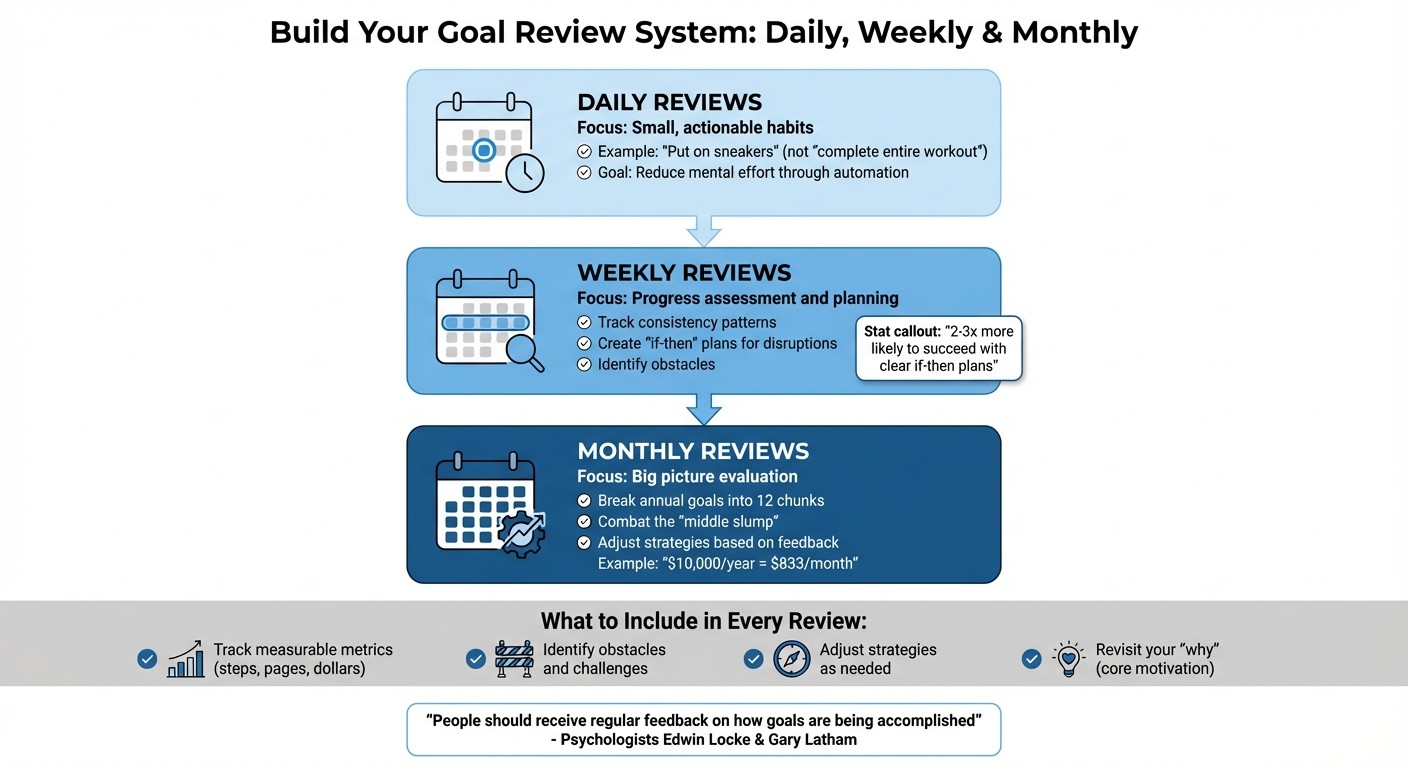
Three-Level Goal Review System: Daily, Weekly, and Monthly Framework
Understanding why your brain thrives on regular reminders is one thing. But setting up a system to make those reminders stick? That’s where the real work begins. Without a solid structure, even the best intentions can fizzle out. By creating a routine that fits into your life, you can ensure your goals stay front and center. Let’s dive into how to build a practical system with daily, weekly, and monthly reviews.
Setting Up Daily, Weekly, and Monthly Reviews
A strong review system operates on three levels: daily check-ins, weekly evaluations, and monthly milestones. Each layer serves a unique purpose, keeping you on track from different angles.
For daily reviews, focus on small, actionable habits. Instead of fixating on the entire workout, start with something simple - like putting on your sneakers. That small act can become second nature, reducing the mental effort required to get started over time[1].
Weekly reviews offer a chance to step back and assess your progress. Use tools like calendars or trackers to monitor consistency and identify patterns. This is also the time to create "if-then" plans for potential disruptions. Research suggests that having a clear plan for when, where, and how to work on your goals can make you two to three times more likely to stick with them[9].
Monthly reviews zoom out even further, focusing on the broader picture. Break your annual goal into 12 manageable chunks. For instance, saving $10,000 a year translates to $833 per month. Tackling goals this way helps combat the "middle slump" - that dip in motivation that often hits between the initial excitement and the final push[6]. Psychologists Edwin Locke and Gary Latham emphasize the importance of regular feedback:
"People should receive regular feedback on how [goals] are being accomplished"[2].
What to Include in Your Goal Reviews
Once you’ve established a review schedule, make sure each session covers the essentials. This will help you stay focused and adaptable.
Every review should address three critical areas: tracking progress, identifying obstacles, and adjusting strategies. Start by logging measurable metrics - like steps taken, pages read, or dollars saved. This not only tracks your progress but also builds a sense of accomplishment, which can keep you motivated[6].
Next, pinpoint any challenges that have cropped up. Reflect on what might have disrupted your routine. Was it fatigue? Unexpected distractions? Once you’ve identified the issue, come up with a plan to handle it better next time. As Scott Glassman, a psychologist and director of the Master of Applied Positive Psychology Program at Philadelphia College of Osteopathic Medicine, explains:
"There has to be self-reflection, an evaluative process, either along the way or at different mile markers on the road of change"[1].
Lastly, revisit your core motivation - your "why." Goals that align with your personal values tend to hold up better than those driven by external pressures[2]. If a goal no longer feels relevant or meaningful, it might be time to tweak it or let it go. As James Clear wisely puts it:
"Goals are good for setting a direction, but systems are best for making progress"[7].
Using AI Tools to Track Goals and Progress
Once you've set up your review system, staying consistent becomes the next big hurdle. That's where AI-powered tools step in. These tools are designed to keep your objectives front and center by managing the time-consuming tasks like tracking progress, sending reminders, and turning reflections into actionable steps. Instead of relying solely on willpower, you're building a system that complements how your brain naturally works.
How AI Journaling Keeps You Engaged with Goals
AI journaling platforms simplify goal-setting by automating tasks that often get overlooked. This process, known as cognitive offloading, allows technology to handle the finer details, so you don’t have to. Features like automated reminders, calendar syncing, and regular check-ins ensure your goals remain visible without adding mental clutter.
Take Pausa, for example. This platform lets you journal in just 20 seconds using text, voice, or email. It transforms vague aspirations like "read more" into specific, trackable targets - such as "read 50 pages daily for one month." After you log your thoughts, it generates daily summaries and offers actionable to-do lists to keep you on track[11].
The key to success lies in regular feedback loops. As Scott Glassman, psychologist and director of the Master of Applied Positive Psychology Program at PCOM, explains:
"If you're not getting feedback, you won't know if you need to make adjustments"[1].
AI tools provide this feedback automatically - whether daily, weekly, or monthly - helping you identify potential roadblocks early and adjust your plan accordingly. This ongoing feedback transforms insights into practical routines.
Converting Your Reflections into Action Steps
AI journaling doesn’t just track your progress - it bridges the gap between reflection and action. By analyzing your entries, these tools can uncover patterns, pinpoint challenges, and highlight opportunities you might miss. For instance, if you frequently note feeling exhausted after work, the tool might suggest a tailored "if-then" plan: "If a meeting runs late, then switch to a 10-minute home workout"[8]. These types of plans create automatic cues for positive behaviors, making it easier to stay on track even when motivation wanes.
This approach is backed by research. A 2010 study published in Health Psychology by Peter Gollwitzer and colleagues found that combining implementation intentions with mental contrasting helped a group of German women maintain a healthier diet for two years, while a control group slipped back into old habits[8].
Platforms like Pausa build on this research by offering weekly, monthly, and annual recaps alongside goal-tracking tools. These features allow you to visualize your progress, pinpoint areas where you might be falling behind, and adjust your strategies. It’s more than just logging your thoughts - it’s about creating a personalized system that learns from your experiences and actively guides you toward achieving your goals.
Practical Ways to Stay Engaged with Your Goals
Technology and reviews can help track your progress, but it's your daily routines that truly transform goals into accomplishments. The key lies in adopting deliberate strategies that turn intentions into consistent actions.
Linking Daily Habits to Long-Term Goals
Your daily behaviors have a bigger impact on your future than any New Year's resolution. In fact, research suggests that 45% of our daily actions happen on autopilot[10]. This means your brain is already wired to repeat patterns - you just need to guide those patterns in the right direction.
One way to do this is through habit stacking, a method where you anchor a new behavior to an existing routine. For example, if you want to start reading more, pair it with a morning ritual: "After I pour my coffee, I'll read one page." This way, your established habit (pouring coffee) acts as a trigger for the new one (reading)[10][1].
Wendy Wood, a psychology and business professor at the University of Southern California, explains it best:
"Goals are how we make decisions... But habits are how you stick with a behavior"[10].
Another effective strategy is temptation bundling, which involves combining something you need to do with something you enjoy. Katherine Milkman, a professor at Wharton School, has studied this approach extensively. For instance, you could watch your favorite show while using the treadmill or listen to audiobooks during your commute. This pairing creates a positive association with the task you're trying to make a habit[12][10][1].
You can also reduce friction to make good habits easier. For example, choose a gym that's on your route to work or keep prepped vegetables visible in your fridge to encourage healthier eating. Research shows proximity matters - a study found that people who traveled about 3.5 miles to the gym went five times a month, while those with a commute over five miles only went once[10].
If you miss a day, follow the "Never Miss Twice" rule. Missing one day is a hiccup, but missing two in a row can start forming a new, unwanted habit.
These small, intentional strategies help build a foundation for achieving your goals over time.
Dividing Goals into Smaller Milestones
While daily habits set the stage, breaking your goals into smaller milestones ensures steady, measurable progress. Big, annual goals often feel overwhelming or too distant to inspire action. Breaking them into manageable, time-bound milestones makes them more tangible and achievable.
Milestones also trigger a dopamine boost, which reinforces your motivation to keep going. Scott Glassman, director of the Master of Applied Positive Psychology Program at Philadelphia College of Osteopathic Medicine, highlights this:
"When you feel good about small steps of progress, which we often miss, we are more likely to continue because there's that positive jolt of dopamine"[1].
Start by scaling down to the smallest step possible. For example, if "read 30 books this year" feels daunting, commit to reading just one page a day. James Clear, author of Atomic Habits, refers to this as the establishment phase:
"It has to become the standard in your life before you can scale it up and turn it into something more"[10].
Once reading one page becomes second nature, you can gradually increase your goal. The idea is to let the behavior become part of your identity before worrying about big numbers.
Setting time-bound sub-goals also helps maintain urgency without overwhelming you. For instance, instead of "lose 20 pounds in 2026", aim for "lose 1.5 pounds this month." Or, instead of "save $6,000 by December", target "save $500 by February 1st." These shorter deadlines provide regular checkpoints to evaluate your progress and adjust your approach if needed[2][1].
For physical goals, consider incremental ramping. If your goal is to walk 10,000 steps a day, start with your current average - say, 5,000 steps - and increase by 1,000 every two weeks. A 2016 study found that people with challenging walking goals walked more than those with easier ones, even if they didn’t hit the final target. The act of progressing itself became the motivator[2].
Visual tracking is another powerful tool for reinforcing milestones. For example, the "Paperclip Method" involves moving a paperclip from one jar to another each time you complete a task. Or you could cross off days on a wall calendar to build a visible streak[9]. These physical reminders help you see progress, even when results aren’t immediately obvious.
Apps like Pausa can make tracking even easier. They automatically log your milestones and provide weekly, monthly, and annual summaries. This lets you identify patterns, address areas where you're falling behind, and celebrate small wins that might otherwise go unnoticed. By turning your daily reflections into a visual record, tools like these keep your long-term goals connected to your everyday actions.
Conclusion
Setting yearly goals without regular check-ins is like planting a seed but never watering it. Your brain isn’t designed to hold onto something you wrote down a year ago and then forgot about. Research supports this: a meta-analysis of 138 studies with nearly 20,000 participants found that frequent progress monitoring significantly increases the chances of success[13].
The key to achieving your goals lies in staying engaged with them. Daily habits, weekly reviews, and monthly check-ins help keep your objectives in focus. Breaking down big goals into smaller, manageable steps and tying them to your existing routines allows you to work with your brain’s natural tendencies rather than against them. It’s all about channeling your automatic behaviors toward what truly matters.
Tools like Pausa make this process easier. With features like AI-powered recaps, pattern recognition, and actionable to-dos, the platform helps you stay aligned with your long-term vision. You can journal in just 20 seconds using text, voice, email, or WhatsApp - removing the barriers that often cause people to give up.
This approach is backed by research. As Benjamin Harkin, PhD from the University of Sheffield, explains:
"Monitoring goal progress is a crucial process that comes into play between setting and attaining a goal, ensuring that the goals are translated into action"[13].
Your goals need regular attention and fine-tuning to thrive.
Start small. Choose one review method - whether it’s habit stacking, a Sunday check-in, or using Pausa - and begin this week. By building this system now, you’ll create a foundation for ongoing progress instead of waiting until next January to start over. Regularly revisiting your goals turns fleeting resolutions into lasting achievements.
FAQs
What’s the best way to make goal reviews a daily habit?
To make reviewing your daily goals a regular habit, keep it straightforward and quick. Dedicate just 2-5 minutes at the same time each day - morning or evening works well - and tie it to something you already do, like brushing your teeth or having your morning coffee. The trick is to stay consistent so it becomes second nature.
Use a journal, whether digital or on paper, to jot down a few key points: what you accomplished yesterday, any obstacles you faced, and one or two main actions for today. If journaling feels like a chore, you can lean on AI tools to provide prompts or even highlight patterns in your progress. For a visual boost, try using a habit tracker or checklist to see your progress at a glance - it can be surprisingly motivating.
Before wrapping up, take a moment to connect your daily tasks to your broader goals. If something feels off, tweak your plan for the next day. End your review by identifying one clear action and scheduling it. This simple step helps turn your plans into real progress and keeps you focused on what truly matters.
How can I break big goals into smaller, manageable steps?
Breaking down big goals into smaller, manageable steps makes them easier to achieve and keeps you motivated along the way. Start by identifying your main objective, then break it into specific, measurable milestones. Assign deadlines to each step, and don’t forget to celebrate the small victories as you progress.
Let’s say your goal is to run a marathon (26.2 miles). You might begin by running 3 miles three times a week during the first month. Over the next few months, you can gradually increase your distance, aiming to complete a half-marathon (13.1 miles) by month six. This milestone serves as an important checkpoint on your way to the full race.
Or, if you’re working toward saving $10,000 for a down payment, you could set up an automatic transfer of $833 each month into a high-yield savings account. To stay on track, review your progress every three months. Celebrate each $2,500 milestone with a small, affordable treat to keep your spirits high.
Breaking your goals into actionable steps provides a clear roadmap to success while helping you stay motivated and focused.
How can AI journaling help you stay on track with your goals?
AI journaling takes goal-setting to the next level by turning it into a more personalized and interactive experience. By analyzing your journal entries, it can spot patterns and offer practical advice. For example, it might reveal when you’re at your most productive, pinpoint emotional triggers that could hinder your progress, and recommend breaking down big goals into smaller, more achievable tasks.
It doesn’t stop there. AI journaling tracks your progress in real time, offering visual insights into how small, daily actions - like fitting in a quick 10-minute workout or jotting down reflections - build toward your larger goals. It also provides customized prompts and reminders to help you revisit your objectives, tweak timelines, and celebrate small victories, ensuring your goals remain front and center all year long.
On top of that, AI journaling brings an emotional layer to the process. By analyzing your writing, it can pick up on signs of frustration or burnout. If needed, it might suggest revising overly ambitious goals or incorporating rest into your schedule, helping you stay motivated and balanced as you work toward achieving your aspirations.