
Execution Is a Daily Problem, Not a Yearly One
Jan 2, 2026
Stop relying on distant deadlines—use small daily actions, habit tracking, and time-blocking to beat procrastination and reach long-term goals.
Each January, millions set ambitious goals - losing weight, writing a book, or learning a new skill. Yet, 90% fail to achieve them. Why? Long-term goals often lead to procrastination, as distant deadlines make daily actions feel unimportant. The solution? Focus on small, daily tasks rather than overwhelming yearly targets.
Key points:
Procrastination is common: 20% of adults and 95% of students struggle with it.
Yearly goals lack urgency: Distant deadlines reduce motivation to act today.
Daily actions drive results: Breaking goals into manageable steps increases chances of success.
Habits matter: 40% of daily behavior is habit-driven. Simple, repeatable actions build momentum.
Track progress daily: Tools like journaling or time-blocking make it easier to stay consistent.
Instead of setting lofty annual resolutions, focus on what you can control today. Consistency, not perfection, leads to real progress.
Micro Habits To Improve Productivity and Focus - Tips from a doctor-researcher
Why Yearly Goals Often Fail
Yearly goals often fall victim to time inconsistency - a concept from behavioral economics where the brain places a higher value on immediate rewards than on future benefits [2]. When December 31st feels a lifetime away, it's easy to prioritize today's comfort over tomorrow's success. The distant deadline creates a false sense of security, making it tempting to push tasks to "someday", which often translates to "never" [1].
The statistics back this up: around 90% of people fail to achieve their goals [9]. This isn't due to a lack of motivation or effort. It's a problem of structure. Without immediate accountability, life's distractions effortlessly fill the gap between good intentions and actual execution.
Annual Resolutions Lack Specificity
Goals like "lose 20 pounds this year" or "write a book by December" may sound impressive, but they often lack the clarity needed for action. These are lag measures, or outcomes that depend on many factors beyond your daily control [3]. You can't drop 20 pounds in a day, but you can commit to a 30-minute workout. Without breaking these big goals into manageable daily actions - what experts call lead measures - they remain vague aspirations rather than actionable plans.
Research highlights the importance of implementation intentions, which involve specifying exactly when, where, and how you'll complete a task. This approach can make you 2x to 3x more likely to follow through [2]. Yet most yearly goals skip this critical step. For example, "get healthier" doesn’t tell you what to do at 7:00 AM on a Tuesday. This lack of clarity drains mental energy as you repeatedly decide whether to act, often leading to decision paralysis [3].
Distant Deadlines Encourage Procrastination
When your deadline is months away, procrastination feels almost logical. As John Brandon, Contributing Editor at Inc.com, puts it:
"Procrastination is an act of letting our daily goals get obscured by the long-term goals because that's the easier way to live" [1].
This distant timeline fosters a false sense of security, where simply planning the goal tricks your brain into feeling accomplished. This illusion reduces your motivation to take concrete steps [3].
A great example of avoiding this trap comes from author James Clear. Between 2012 and 2015, he committed to publishing a new article every Monday and Thursday instead of setting distant subscriber targets. This schedule-driven approach removed the temptation to delay. As Clear explains:
"The problem is this: we set a deadline, but not a schedule" [8].
Next, we’ll dive into how focusing on daily actions can close the gap between setting goals and achieving them.
How Daily Action Creates Real Progress
Bridging the gap between planning and execution becomes easier when you focus on small, daily actions. Tackling manageable tasks each day requires less mental effort and makes even the most daunting goals feel achievable.
The trick lies in tracking what you can control today. These are called lead measures - actions like committing to a 30-minute workout - instead of lag measures such as losing 20 pounds or completing a manuscript [3]. By focusing on what you can do now, you reduce mental strain and build a sense of control, allowing you to see tangible progress as it happens. This daily approach also aligns with the science of habit formation.
For example, a study published in the Journal of Applied Psychology (January 2024) found that volunteers with smaller, measurable subgoals (e.g., 4 hours weekly or 8 hours biweekly) contributed 7%–8% more time than those with only a single annual target. These subgoals added up to thousands of extra counseling hours [10].
Why does this work? About 40% of our daily behaviors are driven by habits [11]. Repeating small, consistent actions shifts behaviors from deliberate effort to automatic response. Your brain operates on a feedback loop - cue, craving, response, reward - that minimizes the need for constant willpower [14][13]. Tools like Pausa make maintaining this process even easier. With just 20 seconds of journaling via text or voice, you can log achievements, spot trends, and adjust your strategy without the hassle of lengthy check-ins.
The Science Behind Daily Habits
Repetition builds momentum. Each time you complete a small task, you strengthen a neural pathway, making the habit easier to repeat. The key is to start small. If reading an entire chapter feels overwhelming, start with just one page [4]. The simpler the action, the harder it is to resist [11].
As Cal Newport, author and professor, explains:
"Once you're making consistent and disciplined progress on small things that reflect your larger values, your identity evolves" [5].
By focusing on consistent, manageable steps, you move from merely wanting to be disciplined to actually living it. The "Never Miss Twice" rule reinforces this shift: if you falter on a habit, prioritize getting back on track immediately rather than striving for perfection [11]. Once a habit becomes second nature, regular reflection helps fine-tune and strengthen it.
Why Reflection Matters for Progress
Daily reflection helps you stay on course. A quick two-minute check-in can sharpen your focus and keep you aligned with your goals [4]. Skipping this step means missing out on valuable insights - like recognizing what's draining your energy or identifying areas that need tweaking.
The most effective reflection prioritizes process over outcomes. As Cal Newport suggests:
"Judge your day on how well you executed your productivity process, not the details of what you actually produced" [6].
Instead of obsessing over every item on your to-do list, think about whether you protected your focus time or followed through on your plans. AI tools can make this even simpler. For instance, Pausa's AI-powered summaries automatically highlight patterns in your daily reflections, offering a clear view of your progress and actionable next steps - without the mental burden of traditional journaling.
Turning Goals into Daily Tasks with Pausa

Transforming big goals into manageable daily actions doesn’t have to be overwhelming. Pausa’s AI-powered journaling simplifies the process, turning reflection into a daily habit. This removes the mental fatigue that often comes with traditional goal-tracking methods.
Instead of staring at a blank page, Pausa provides tailored prompts to keep you focused. The AI learns your style and suggests actionable tasks, making your daily entries a roadmap for tomorrow. Research supports this approach, showing that daily check-ins are easier to maintain than monthly ones because they help you stay in the "flow" of your routine [4]. This daily rhythm also makes it easier to use AI tools to track and refine your progress.
Using Pausa's 20-Second Daily Journaling
When it comes to building habits, speed is key. Pausa lets you capture your thoughts in just 20 seconds through text, voice, email, or WhatsApp, keeping the process friction-free.
The focus here is on tracking actions, not just results. For instance, instead of logging "lost 2 pounds", you’d note "completed a 30-minute workout." By emphasizing behaviors you can control, you gain a stronger sense of ownership [3]. Pausa’s AI picks up on patterns and offers helpful suggestions - if you’ve been logging morning workouts, it might prompt you to schedule your next session or prepare your gym bag.
Big goals can feel less daunting when broken down into a single, actionable sentence. This keeps the habit sustainable [4]. Over time, the AI learns from your entries, helping you expand your capacity naturally without imposing rigid structures.
Tracking Progress with Pausa's Recap Features
Pausa doesn’t just collect your daily entries - it turns them into meaningful insights. With summaries available daily, weekly, monthly, and annually, you can clearly identify where you’re excelling and where adjustments might be needed. These recaps analyze patterns in your emotions, decisions, and habits, offering a deeper understanding of your progress.
The summaries also highlight trends in productivity, helping you fine-tune your routines for better results. Dynamic charts and milestone tracking transform your goals into visible, achievable steps, allowing you to celebrate wins along the way. If you consistently surpass your targets, the AI might suggest raising the bar, making sure your habits grow alongside your progress.
AI Journaling Methods for Focus and Reflection
Feeling mentally drained? You're not alone. With the average person making around 35,000 decisions daily, it's no wonder we sometimes feel overwhelmed and stuck [12]. That’s where Pausa’s AI-powered journaling comes in - it clears the noise, helping you concentrate on what truly matters.
Pausa uses AI to shift your focus from chasing vague outcomes to tracking actions you can control. Instead of worrying about big-picture results, it encourages small, actionable steps - like completing a daily journal entry or dedicating 30 minutes to focused work [3]. The idea is simple: measurable effort leads to meaningful progress.
Voice Input and Goal Tracking
Journaling doesn’t have to be a chore. Thanks to Pausa’s voice input feature, you can record your thoughts in seconds - no typing required. Whether you're commuting, in the middle of a hectic day, or just too tired to write, voice journaling makes it easy to stay consistent.
Here’s the cool part: Pausa’s AI doesn’t just store your thoughts; it analyzes them. For instance, if you mention “worked on presentation” multiple times in a week, it recognizes this as progress toward a larger goal. The system then adjusts its prompts to reflect your efforts, removing the need for manual tracking. This seamless process keeps you focused on taking action rather than getting bogged down in the details.
Daily Reflective Prompts for Better Clarity
Pausa takes journaling a step further with daily reflective prompts designed to turn your thoughts into actionable insights. These prompts bridge the gap between what you plan to do and what you actually accomplish. By tailoring questions to your past entries, the AI creates a personalized accountability system that evolves with you.
Want to build daily journaling habits? Try pairing it with an existing routine. For example, commit to journaling for five minutes right after your morning coffee [3]. Pausa’s prompts can help reinforce this habit. It also applies the “70% Rule” - if you have 70% of the information you need, take action instead of waiting for perfect clarity [3]. This approach helps you avoid overthinking and keeps you moving forward.
"You do not rise to the level of your goals. You fall to the level of your systems." - James Clear [12]
Think of Pausa as your personal accountability partner. It tracks your progress, refines your routines, and offers suggestions to keep you on track - all without adding extra stress. These AI-driven tools make it easier to stay committed, turning your intentions into daily achievements.
Time-Blocking and Habit Tracking in Pausa
Planning is one thing, but turning plans into action is another. That gap often holds us back. Pausa bridges this divide by combining time-blocking and habit tracking into a system that transforms vague intentions into tangible results. Together, these tools create a feedback loop that drives daily progress.
Prioritizing Tasks with Time-Blocking
Time-blocking is more than just filling your calendar - it’s a way to combat Parkinson’s Law, which says that work tends to expand to fill the time available [16]. By assigning specific hours to tasks, you set clear intentions and reduce the need to rely on fleeting willpower.
Weekly recaps in Pausa help you compare your planned schedule to what actually happened. For instance, you might block two hours for focused work but find distractions cut that down to just 45 minutes. This insight helps you refine your future time blocks for better results.
A good starting point is choosing one "Highlight" - a top-priority task to focus on each day [15]. Even if the rest of your day gets derailed, this ensures you’ve made meaningful progress. Tools like the Eisenhower Matrix can help you zero in on tasks that are "Important but Not Urgent" [7].
"You can't call something a distraction unless you know what it is distracting you from." - Nir Eyal, Author [16]
Focus on lead measures, which are actions you can control, like “30 minutes of writing,” rather than waiting for results to show up. Tracking behaviors instead of outcomes gives you a sense of control and keeps you motivated. To maintain momentum, set a minimum effective dose (e.g., 15 minutes of effort) and a maximum limit to avoid burnout [17].
Building Consistency with Habit Tracking
Habit tracking works hand-in-hand with time-blocking to build consistency in your daily routines. While motivation can fade, systems stick around. In Pausa, habit tracking matters because it creates a record of your daily actions - a clear reflection of the person you’re becoming [5]. Sometimes, the simple act of not wanting to miss a day is enough to get you started.
A 2001 study in Great Britain found that people who planned their habits - writing down specifics like, “I will exercise for at least 20 minutes on [DAY] at [TIME] in [PLACE]” - achieved a 91% success rate. By contrast, those who relied on motivation alone achieved only a 35–38% success rate [18]. This kind of precise planning turns long-term goals into achievable daily wins.
Pausa’s daily and weekly recaps give you a clear view of your progress. Whether you’re tracking simple habits (like “Did I journal today?”) or measuring something more detailed (like minutes spent on focused work), these reviews allow you to tweak your timing or environment rather than lowering your goals [17].
"Stop waiting for motivation or inspiration to strike you and set a schedule for your habits." - James Clear, Author [15]
To make new habits stick, try anchoring them to existing routines. For example, pair a challenging task with something enjoyable, like listening to your favorite podcast while you work. You can also use the 2-Minute Rule: scale new habits down to something so easy it takes less than two minutes to start [19]. The aim isn’t perfection - it’s about showing up consistently until the habit becomes part of who you are.
Yearly Goals vs. Daily Execution: A Comparison
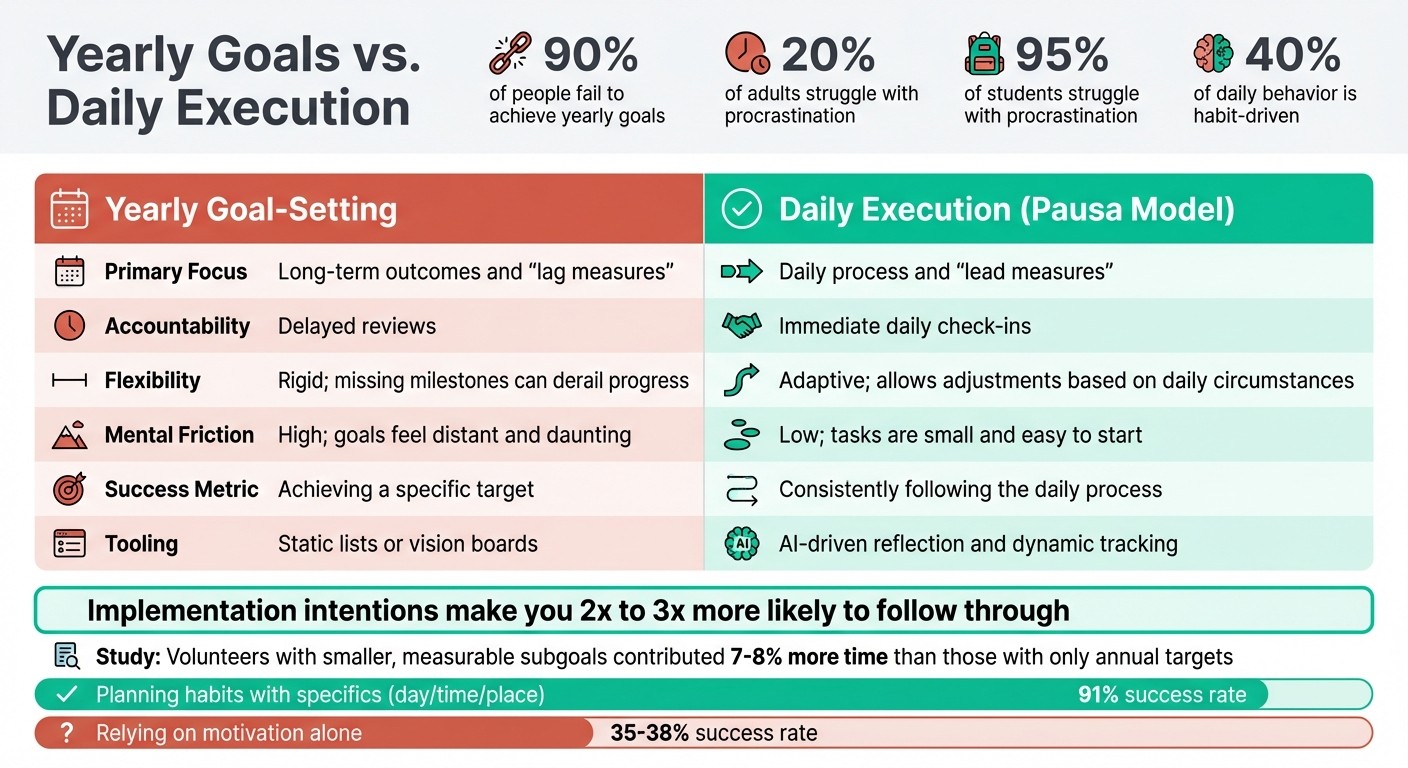
Yearly Goals vs Daily Execution: Key Differences and Success Rates
Yearly goals aim for outcomes far in the future, like "lose 20 pounds" or "write a book." These are what we call lag measures - results you can only evaluate after completing the necessary work. On the other hand, daily execution emphasizes lead measures, the actions you can control right now, such as "do a 30-minute workout" or "write for 15 minutes." This action-oriented approach gives you a sense of control and keeps your motivation alive by focusing on what’s achievable today.
Yearly goals often fall victim to procrastination because they rely on infrequent check-ins. Daily execution, however, demands immediate accountability with quick, consistent reviews. As Cal Newport explains:
"Judge your day on how well you executed your productivity process, not the details of what you actually produced" [6].
This daily focus not only curbs procrastination but also adds flexibility. If your day doesn’t go as planned, you can adjust and re-prioritize tasks. Yearly goals, in contrast, tend to feel rigid - miss a milestone, and it can feel like failure. By breaking big goals into smaller, manageable tasks, daily execution reduces the mental friction of starting something that feels overwhelming.
Comparison Table
Here's a side-by-side breakdown of the differences:
Feature | Yearly Goal-Setting | Daily Execution (Pausa Model) |
|---|---|---|
Primary Focus | Long-term outcomes and "lag measures" | Daily process and "lead measures" |
Accountability | Delayed reviews | Immediate daily check-ins |
Flexibility | Rigid; missing milestones can derail progress | Adaptive; allows adjustments based on daily circumstances |
Mental Friction | High; goals feel distant and daunting | Low; tasks are small and easy to start |
Success Metric | Achieving a specific target | Consistently following the daily process |
Tooling | Static lists or vision boards | AI-driven reflection and dynamic tracking |
When it comes to consistency, schedules outperform deadlines. James Clear puts it this way:
"If you want to be the type of person who accomplishes things on a consistent basis, then give yourself a schedule to follow, not a deadline to race toward" [8].
The Pausa model brings this idea to life by creating a system that adapts to your day-to-day reality rather than demanding perfection.
Conclusion
Real progress isn’t about waiting for some distant milestone - it’s built in the small, consistent actions you take every day[1][3]. When you make a habit of showing up daily, you start to see yourself as someone who follows through, someone capable of handling challenges[5]. That mindset shift lays the groundwork for achieving your bigger ambitions. The best part? This approach feels manageable. A quick 20-second journal entry in Pausa takes far less effort than trying to tackle an overwhelming yearly goal. By focusing on the process instead of obsessing over the outcome, you keep your momentum alive. Research backs this up: evaluating your day based on how well you stick to your process helps you stay on track[6].
Pausa makes this even easier with its AI-driven insights and smart notifications, turning your intentions into actionable steps. Users have shared how consistent journaling has boosted their emotional clarity and improved decision-making. It’s a simple yet effective way to tie your daily habits to long-term success.
Why not start today? Open Pausa and jot down a quick 20-second journal entry - whether it’s about what you accomplished or what’s on your mind. Pair this habit with something you already do, like sipping your morning coffee or shutting down your laptop at the end of the day. That small step can snowball into habits that transform over time.
Your goals don’t rely on perfect plans - they’re built by the small, consistent actions you choose to take today.
FAQs
What’s the best way to break down yearly goals into daily tasks?
To break down big yearly goals into manageable daily tasks, start by defining your main objective for the year. For instance, let’s say your goal is, "Launch a $50,000 online course by 12/31/2026." Next, divide this into smaller, quarterly steps - like researching your market in the first quarter or creating course content in the second. From there, break those quarterly steps into monthly targets. For example, January could focus on surveying potential customers, while February might involve drafting course modules.
When it comes to daily execution, try the 1-3-5 rule. This means tackling 1 big task (like drafting a module), 3 medium tasks (such as editing slides or scheduling interviews), and 5 smaller tasks (like answering emails or organizing files). Use a digital calendar to assign specific time blocks for each task, ensuring they fit into your day. At the end of each day, take a moment to review your progress, make any necessary adjustments, and keep moving forward. By taking consistent, focused action every day, those long-term goals become much more attainable.
How can I build consistent daily habits to achieve my goals?
Building consistent daily habits begins with small, easy-to-do actions that naturally blend into your everyday life. Start by choosing a micro-habit - something super simple, like doing one push-up or drinking a glass of water. Pair this new habit with something you already do, like brushing your teeth, to make it easier to remember and kickstart momentum.
To keep yourself accountable, write down when, where, and how you'll practice the habit. Use tools like a habit-tracking app or even a simple checkmark on paper to monitor your progress. Seeing those daily checkmarks adds a sense of achievement and keeps you motivated. Take a moment each day to reflect on what’s working and tweak your approach if needed. As the habit becomes second nature, slowly increase its intensity to keep growing without feeling overwhelmed.
Why is focusing on daily actions more effective for achieving goals?
Focusing on daily actions, often referred to as lead measures, shifts your attention to behaviors you can control that directly impact your progress. These small, actionable steps give you quick feedback, making it easier to tweak your approach and stay aligned with your goals.
When you break big-picture objectives into smaller, daily tasks, it becomes much simpler to build momentum and avoid procrastination. This method keeps your efforts focused and ensures steady progress, helping you work toward meaningful results without feeling overwhelmed.