
How to Stay Human When Content Is Made by No One
Dec 28, 2025
Intentional habits—journaling, critical thinking, and mindfulness—help you spot AI-made content and preserve independent thought.

In a world where AI influences over 50% of web content, staying human requires deliberate effort. AI tools shape decisions, preferences, and even emotions, often without us realizing it. To maintain control, focus on these key strategies:
Build self-awareness: Reflect on your thoughts and decisions. Simple habits like journaling can help you recognize when algorithms are steering you.
Clarify personal values: Define what matters most to you. Use tools to track whether your actions align with your goals.
Spot AI-generated content: Learn to identify patterns like overly polished visuals or repetitive phrasing in text.
Practice critical thinking: Question the accuracy and intent of the content you consume. Verify facts and avoid blind trust in AI recommendations.
Adopt mindfulness: Pause before making decisions. Reconnect with your instincts by limiting reliance on AI for everyday choices.
The challenge isn’t rejecting AI but using it thoughtfully. By staying intentional, you can ensure technology supports your humanity rather than replacing it.
The Death of Thinking? How to Keep Your Brain Sharp in the AI Age
Building Self-Awareness in a Digital World
Self-awareness is one of the most effective ways to avoid being overly influenced by AI. With 78% of organizations and 86% of students now integrating AI into their routines, it's increasingly challenging to separate personal thoughts from those shaped by algorithmic suggestions[5].
When you take time to reflect, you engage your brain's default-mode network, which is crucial for understanding your emotions and your connections to the world[1]. This is something AI simply cannot replicate. Without regular self-reflection, you risk losing the ability to think independently[2].
As Faisal Hoque, Founder of Shadoka, wisely notes:
"Exercising agency requires that we actively shape ourselves through deliberate choices, rather than being passively shaped by algorithms, social norms, or external pressures."
Strengthening this awareness doesn’t demand hours of meditation or complicated routines. Simple, consistent daily journaling habits can help you identify your own voice amidst the noise.
Using Pausa for Daily Journaling
Journaling acts as an "intentional pause", giving you a moment to question whether your decisions are genuinely yours or subtly influenced by algorithms[2]. Pausa simplifies this process, allowing you to jot down your unfiltered thoughts in just 20 seconds. The idea is to capture your raw thinking before AI tools have a chance to shape it.
Try the "Sandwich" Strategy: Before using any AI tool, record your initial thoughts in Pausa[5]. After reviewing the AI's suggestions, revisit your journal to reflect on which ideas resonate with your authentic perspective.
This habit helps preserve your independent thinking[4]. Pausa’s daily recaps can reveal patterns in your thought process, while a Mindfulness Journal lets you track how AI interactions influence your decisions[1]. Over time, you'll become more attuned to when algorithms are steering your attention away from what truly matters to you.
Identifying Your Personal Values and Priorities
Journaling is just the beginning. Defining your personal values is another powerful way to strengthen your judgment. When you’re clear about your values, you can better assess whether AI-driven recommendations align with your goals or simply create distractions.
One way to start is by conducting a weekly Goals Audit using Pausa’s goal tracking feature[1]. List out your daily tasks and evaluate whether they support your long-term ambitions or just reflect AI-driven efficiency.
Before accepting any algorithmic suggestion, take a moment to pause and ask yourself, "Would I have made this choice on my own?" You can also set aside a Curiosity Hour: pick one point from an AI-generated summary and research it independently[1]. Use Pausa to document your discoveries and connect them to what you already know. This intentional inquiry helps you internalize information instead of merely remembering where to find it.
Cornelia C. Walther, Ph.D., Wharton University Fellow, highlights the importance of this approach:
"Mindfulness practices... anchor you in your own thoughts, so AI doesn't dictate your workflow."
The goal isn’t to avoid AI entirely. Instead, it’s about using these tools with intention - letting them enhance your thinking without replacing it. By staying mindful, you can ensure that AI serves as a complement to your judgment, not a substitute for it.
Developing Discernment in Content Consumption
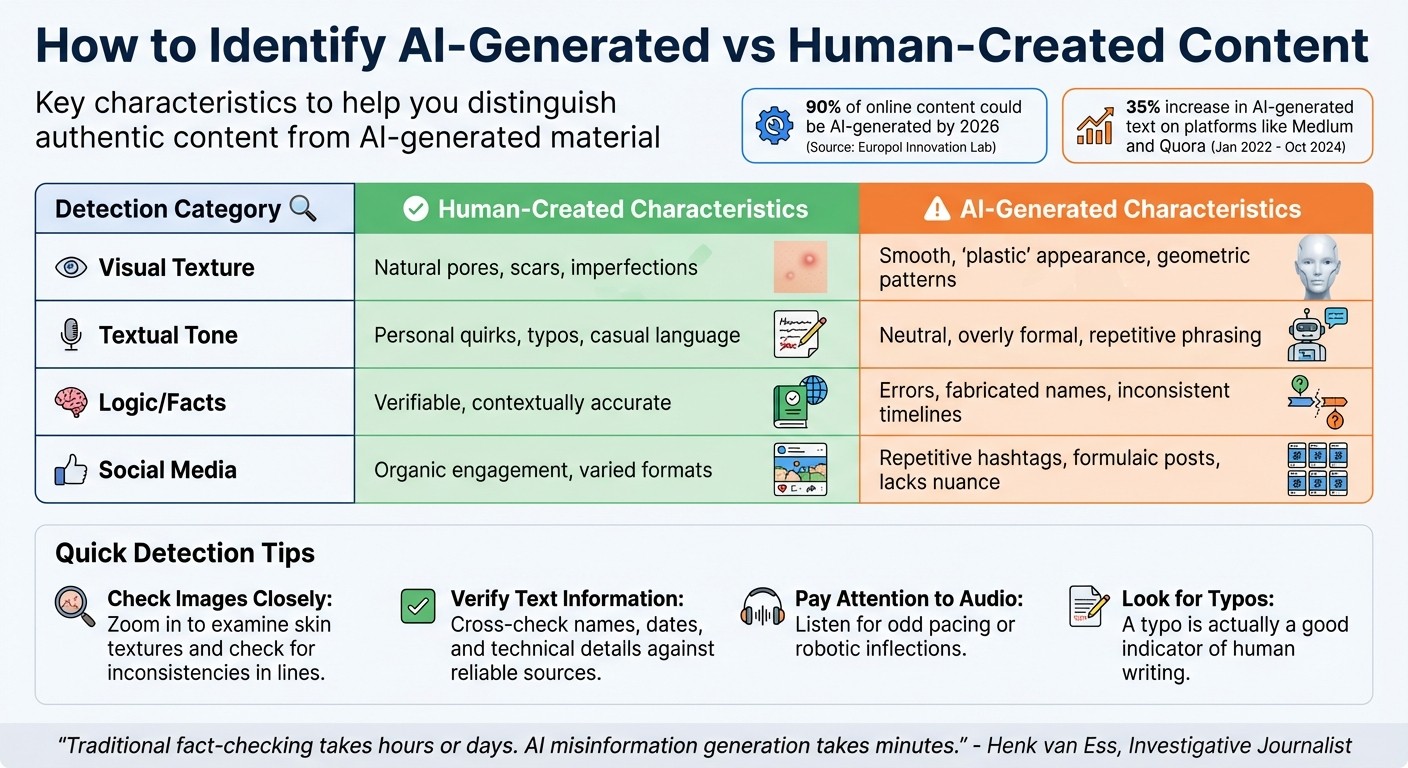
How to Identify AI-Generated vs Human-Created Content
According to a report from the Europol Innovation Lab, 90% of online content could be AI-generated by 2026 [8]. Between January 2022 and October 2024, platforms like Medium and Quora saw a 35% increase in AI-generated text [8]. Alarming as it sounds, research also shows that most people struggle to identify AI-generated text, with accuracy levels no better than random guessing [10]. Without the right tools and skills, spotting AI content becomes a daunting task.
But the challenge isn’t just about identifying fake content - it’s about understanding what you’re consuming before it influences your thoughts. As investigative journalist Henk van Ess aptly puts it:
"Traditional fact-checking takes hours or days. AI misinformation generation takes minutes." [7]
By learning to recognize patterns in AI-generated content, you can focus on material that truly deserves your attention. This isn’t about rejecting technology - it’s about making smarter choices.
How to Spot AI-Generated Content
AI has become impressively skilled at imitating human output, but it still leaves behind subtle clues. For instance, overly polished visuals can be a giveaway. AI-generated images often feature unnaturally smooth skin, perfectly symmetrical faces, or overly groomed details that seem out of place in real-world contexts [7][8]. In contrast, authentic photos usually have irregularities - like pores, scars, or asymmetries - that make them feel real.
When it comes to text, the signs are different. Look for patterns like repetitive phrasing or an unnatural overuse of words such as "delve", "underscores", or "moreover" - common markers of AI-generated writing [9]. Interestingly, as Daphne Ippolito, Senior Research Scientist at Google Brain, observes:
"A typo in the text is actually a really good indicator that it was human written." [10]
Here are some practical ways to sharpen your detection skills:
Check Images Closely: Zoom in to examine skin textures or use tools to check for inconsistencies in lines, like rooflines or tracks. Misaligned perspectives often suggest AI manipulation [7].
Verify Text Information: Cross-check names, dates, and technical details against reliable sources [11].
Pay Attention to Audio: Listen for odd pacing or robotic inflections, especially at the end of sentences [7].
To help you further, here’s a quick comparison of human versus AI-generated content traits:
Detection Category | Human-Created Characteristics | AI-Generated Characteristics |
|---|---|---|
Visual Texture | Natural pores, scars, imperfections | Smooth, "plastic" appearance, geometric patterns |
Textual Tone | Personal quirks, typos, casual language | Neutral, overly formal, repetitive phrasing |
Logic/Facts | Verifiable, contextually accurate | Errors, fabricated names, inconsistent timelines |
Social Media | Organic engagement, varied formats | Repetitive hashtags, formulaic posts, lacks nuance |
Choosing Human-Centric Content
Once you’ve honed your ability to spot AI-generated material, the next step is to actively seek out content rooted in genuine human experience. Human-created content often includes personal stories, emotional depth, and real-life lessons - not just abstract or theoretical data [13]. It feels alive, with varied rhythms, contractions, and even moments of surprise or conflict woven into the narrative.
For instance, while AI can describe grief, only someone who has lived through loss can truly convey its emotional weight. When evaluating content, practice lateral reading - open multiple tabs to see if reputable sources back up the claims [3]. Use tools like Google Lens, TinEye, or Bing Visual Search to verify images [12]. AI content often provides generic scenarios, while human writing frequently includes vivid, personal details [13].
Ask yourself: Does this reflect lived experience, or is it just a polished summary? Keep a journal - tools like Pausa can help you track what resonates with you and why. Over time, you’ll start to trust your instincts in identifying authentic, human-driven insights.
The goal isn’t to approach every piece of content with suspicion. Instead, it’s about being selective, recognizing that your attention is valuable. Not everything deserves to shape your perspective. Developing this discernment helps you engage more thoughtfully with the information you consume.
Strengthening Critical Thinking and Reflection
Recognizing AI-generated content is one thing, but understanding why it resonates with you and influences your decisions takes a deeper level of awareness. Critical thinking means identifying when algorithms start taking over your reasoning process. Studies reveal that consistently relying on AI recommendations can weaken your ability to make independent judgments and erode self-confidence [2]. The solution? Build a habit of reflection - question not only the content you consume but also how it impacts your decisions.
Using Reflective Prompts in Pausa
Pausa's reflective prompts provide a straightforward way to examine your interactions with AI-generated content. After using tools like ChatGPT or scrolling through algorithm-driven feeds, take 20 seconds to journal on two key questions: "Did this deliver what I truly wanted?" and "Which parts reflected my thinking versus the AI's logic?" [14]. This quick practice helps you move from passively accepting AI outputs to actively analyzing them.
Here’s an example: In March 2023, ChatGPT fabricated key details in an economics article, misleading readers who didn’t question its accuracy [11]. By journaling after such interactions, you train yourself to catch these red flags before they shape your opinions.
Pausa also offers goal-tracking features to align your reflections with your deeper values. This deliberate pause - drawing from the Zen concept of "ma" - creates room to separate your genuine preferences from algorithmic suggestions, fostering trust in your instincts.
From here, you can explore actionable ways to integrate this reflective practice using Pausa's tools.
Questioning Algorithmic Influence
Once you've strengthened your reflective habits, the next step is recognizing how algorithms steer your attention. Algorithms are not neutral; they’re designed to maximize engagement by amplifying content that sparks strong reactions - whether it’s outrage, fear, or envy. The real challenge isn’t just spotting AI content but understanding when your attention is being manipulated. As technologist Faisal Hoque points out:
"When algorithms subtly shape our actions without our awareness, we risk drifting further from our authentic selves" [2].
Start by auditing your online feeds. Unfollow accounts that thrive on "outrage-bait" or divisive language [6]. Before diving into social media, set a clear intention - like catching up with friends or researching a specific topic - to avoid slipping into endless, algorithm-driven scrolling [6]. If you encounter a recommendation that seems too perfect or aligns neatly with your biases, practice lateral reading. Open multiple tabs to check what other credible sources say about the claim [3]. Always verify before you trust. Interestingly, 54% of consumers report trusting brands less if they use AI without transparency [15]. Apply the same level of skepticism to the content you engage with daily.
Using Mindfulness to Maintain Authenticity
Mindfulness can be a powerful tool to preserve our sense of authenticity in a world increasingly shaped by AI-generated content. While critical thinking helps us spot the subtle ways algorithms influence our choices, mindfulness ensures we remain in control of our decisions. Relying heavily on AI systems can lead to what researchers term "algorithmic dependence" - a habit that weakens independent judgment and erodes self-trust over time. Mindfulness, on the other hand, engages the brain's default-mode network, which is key to self-reflection and understanding our relationships with others - abilities that AI cannot replicate.
The risks are more serious than many realize. After a digital distraction, it takes the brain an average of 23 minutes to regain full focus [17]. Regular multitasking has been linked to reduced grey matter in the parts of the brain responsible for empathy and emotional regulation [17]. Additionally, over-reliance on tools like search engines and GPS can lead to a less active hippocampus, the brain's center for memory and spatial reasoning [17]. As enterprise transformation strategist Arman Kamran explains:
"The brain, like a muscle, obeys the law of disuse. Neurons that fire together wire together - but neurons that remain idle weaken" [17].
Mindfulness doesn’t mean rejecting technology outright. Instead, it’s about maintaining what researchers call "cognitive sovereignty" - the ability to decide where to focus your mental energy, rather than letting algorithms make that choice for you. Practicing intentional pauses can help with this. For instance, before clicking on a recommended video or accepting an AI-generated answer, take a moment to ask yourself: Is this decision truly my own? This simple practice can help you engage with digital content more thoughtfully.
Mindful Content Consumption
To use technology more mindfully, start by paying attention to your physical and emotional state. For example, check in with your breath or notice any tension in your body - these can signal when you’re feeling overwhelmed by digital input [16].
You might also try the Recall-Before-Search Rule: before asking AI for information, pause for 20 seconds and attempt to recall the answer yourself. This small habit engages the hippocampus, helping to strengthen memory and reduce reliance on external tools. Similarly, consider implementing 45-minute focus sprints - dedicating uninterrupted time to a task without switching between devices. This practice can help rebuild your ability to concentrate.
Another way to nurture mindfulness is by making everyday decisions without relying on technology. For instance, pick a restaurant without reading online reviews or choose a book by browsing a physical shelf. These small acts can rebuild confidence in your instincts. Interestingly, users who spent just five minutes on a digital well-being solution reported saving an average of 49 minutes of screen time per day [6].
When you do use AI, think of it as a collaborator rather than a decision-maker. Instead of accepting its answers outright, let it challenge your assumptions. As Kamran puts it:
"The healthiest human-AI dynamic is not substitution but symbiosis. Instead of letting AI think for us, we can make it think with us" [17].
This approach introduces a level of mental effort, or "cognitive friction", that is essential for growth. Paired with mindful practices, tools like Pausa can help you stay focused on your personal goals and values.
Tracking Personal Goals with Pausa
Mindfulness works best when it’s paired with clear direction. That’s where tools like Pausa come in. Its goal-tracking features - combined with journaling and reflective prompts - help you stay aligned with your core values and priorities. By setting meaningful goals, you can tap into your brain’s reward system, boosting both motivation and productivity [1].
Start by defining your "why." Instead of vague goals like "spend less time on my phone", aim for specific habits, such as "no phone use after dinner" or "limit TikTok to one hour per week" [18]. Pausa makes it easy to record these commitments using text or voice input, a process that takes just 20 seconds.
Pausa also offers daily and weekly recaps to help you evaluate whether your actions align with your long-term ambitions [1]. This regular reflection can prevent you from falling into algorithm-driven habits that prioritize engagement over your true priorities. You can even pair this practice with habit stacking - like meditating or setting an intention before using a device, then journaling about the experience afterward [6].
Dan Nixon, a writer and researcher, highlights the importance of these small, consistent efforts:
"Through continually renewing a caring, curious attitude in our online spaces and interactions we can slowly but surely work to build digital environments that bring out the best in our humanity" [16].
Pausa’s actionable suggestions help turn these reflections into tangible steps, ensuring you stay focused on pursuits that enrich your life rather than distractions. By practicing epistemic humility - the ability to admit "I don’t know" - you can resist the certainty that often accompanies AI-generated content and make room for genuine growth [1].
Conclusion
In an AI-driven world, staying connected to our humanity comes down to the choices we make in how we interact with technology. The strategies shared here - like journaling to build self-awareness, being selective about what you consume, sharpening critical thinking, and practicing mindfulness - require deliberate effort. As Faisal Hoque, founder of Shadoka, puts it:
"To be human is to choose. It is to exercise the human capacity for intentional action, the ability we have been given to be the authors of our own lives." [2]
These mindful habits don't just keep us grounded - they can also counteract the subtle effects of over-reliance on technology. Studies show that frequent digital interruptions or leaning too heavily on tools like search engines and GPS can decrease activity in the hippocampus, the brain's memory hub [17]. The good news? Small, consistent actions can help reverse these trends. Whether it's a 20-second journal entry, a reflective question, or tracking goals that align with your values, tools like Pausa make it easier to integrate these practices into daily life.
By committing to these intentional habits, you protect what matters most: your cognitive autonomy - the ability to control your focus and shape your thoughts. As innovation theorist John Nosta reminds us:
"Intelligence isn't just about knowing - it's about thinking, questioning, and creating. This future won't belong to those who simply have access to AI-generated knowledge. It will belong to those who still know how to wrestle with the unknown." [1]
Through these practices, you ensure that you remain in charge of your relationship with technology, keeping your mind sharp and your choices intentional.
FAQs
How can I recognize if content was created by AI?
AI-generated content often carries certain clues that set it apart. For starters, it might come across as too polished or repetitive, frequently using generic phrases like "in today’s world" or "as you know." This type of writing often lacks the personal touch, such as specific anecdotes, nuanced perspectives, or even the occasional small error that gives human writing its unique character. Another common giveaway? Confidently presented factual inaccuracies or random combinations of unrelated details.
Pay attention to the tone - AI content can feel inconsistent, with abrupt topic shifts or an overly formal style. It often steers clear of idiomatic expressions and tends to produce sentences that are all about the same length, which can make the text feel monotonous. If you’re still unsure, try probing deeper by asking follow-up questions. Human writers usually respond with detailed, specific insights, while AI might offer vague answers or repeat itself. Recognizing these patterns can help you spot the difference between human and AI-generated content.
How can I stay self-aware in a world filled with AI-generated content?
Staying aware of yourself in a world increasingly influenced by AI starts with small, deliberate actions. Begin by questioning the content you interact with. Ask yourself, “Who created this, and what’s their purpose?” Pay attention to clues like overly polished language or a lack of author details - these can hint at AI-generated material. Practicing this regularly hones your ability to spot what feels genuine.
Another helpful habit is setting aside a few minutes each day to reflect on the content that left the biggest impression on you. Jot down your feelings about it - did it seem authentic, or did it feel artificial? This simple act of journaling keeps you grounded and in touch with your own reactions.
Lastly, approach media with a critical eye. Before you share or accept any information, take a moment to check its accuracy. Look for evidence, compare it across different sources, and think critically about its intent. These habits help you stay engaged and ensure that your unique perspective and emotional connection remain intact in the digital age.
How can mindfulness help you think independently in an AI-driven world?
Mindfulness gives you the power to pause and think before reacting to an AI suggestion. This small but meaningful pause lets you reflect, weigh your options, and decide if the input aligns with your intentions, keeping your decisions firmly in your hands. By staying grounded and aware, mindfulness helps you avoid knee-jerk reactions and sharpens your critical thinking.
Incorporating mindfulness practices - like focused breathing, body scans, or journaling - can heighten your awareness of how algorithms might influence your choices. This awareness enables you to deliberately set your own objectives, carefully evaluate AI-generated content, and preserve your personal autonomy in a tech-driven world.