
Why Silence Is the Only Antidote to AI Slop
Dec 26, 2025
AI-generated 'slop' floods feeds and dulls thinking; silence—journaling, device-free zones, and mindful breaks—restores focus, memory, and creativity.

Your digital world is overflowing with AI-generated content - emails, social media posts, and even books. While it looks polished, much of it lacks depth and substance. This phenomenon, called "AI slop", clutters your mind, disrupts focus, and weakens critical thinking.
Here’s the problem:
Over 50% of web content is now AI-generated or edited.
AI tools often create errors, repetitive phrases, and shallow ideas.
Workers spend nearly 2 hours per day sorting through low-quality AI content.
Heavy reliance on AI lowers brain activity and damages creativity.
The solution? Silence. Taking intentional breaks from digital noise resets your brain, improves focus, and encourages deeper thinking. Simple habits like journaling, tech-free zones, and mindfulness can help you regain clarity and reduce dependence on AI.
Key Takeaways:
Silence combats the "fluency illusion" caused by AI’s smooth but empty output.
Quiet moments improve memory, judgment, and mental sharpness.
Techniques like device-free mornings or mindful breaks create space for original thought.
In a world drowning in AI slop, silence isn’t just helpful - it’s necessary for reclaiming your mind.
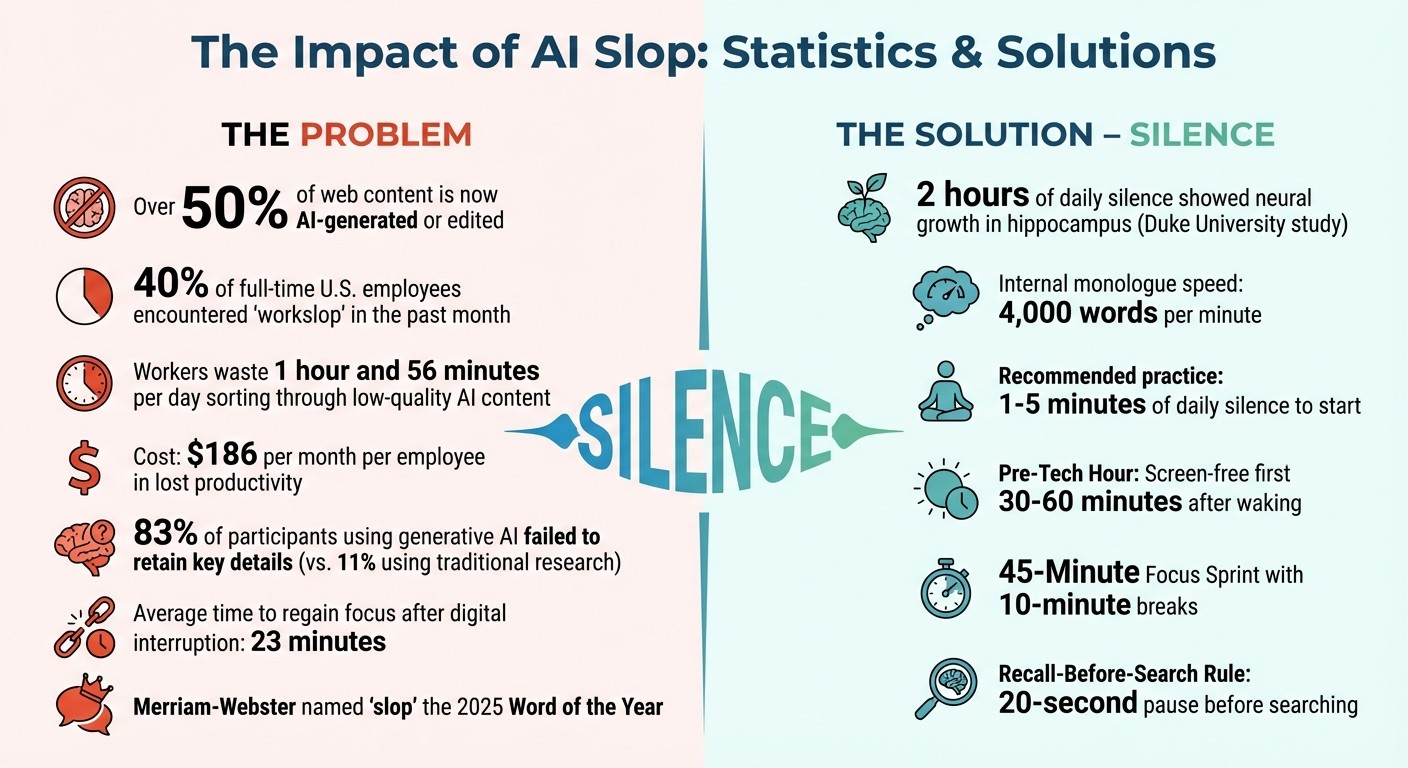
The Impact of AI Slop: Key Statistics on Digital Content Overload
AI Content Overload: Why ‘AI Slop’ Is Flooding Your Social Media Feeds in 2026
What AI Slop Is and How It Affects You
AI slop has been dubbed the "junk food of the internet" [12] - content churned out quickly by artificial intelligence with minimal human input. It prioritizes quantity over quality, flooding digital spaces with shallow, repetitive material. This overload doesn’t just disrupt professional workflows; it also interferes with everyday online experiences.
The consequences are more than just inconvenient - they’re measurable. 40% of full-time U.S. employees reported encountering "workslop" (low-effort AI-generated content) in the past month alone [10]. On average, dealing with this type of content wastes about 1 hour and 56 minutes per instance, translating to an unseen cost of $186 per month per employee [10]. That’s nearly two hours of your day lost to sifting through uninspired, generic material that clutters your digital environment.
The issue isn’t limited to workplaces. The sheer volume of this content creates a "wall of noise", making it harder to find trustworthy, human-created information. The term "slop" has become so widespread that Merriam-Webster named it the 2025 Word of the Year [11].
Common Traits of AI Slop
AI slop is easy to spot once you know what to look for. It often features repetitive, formulaic phrasing, like "In the year 2250..." or "Imagine a world where..." [13]. While it might read smoothly, it often lacks any real personality or emotional depth, leaving no lasting impression.
Another major issue is its tendency toward factual errors and outright fabrications, often referred to as "hallucinations." For instance, the peer-reviewed journal Frontiers in Cell and Developmental Biology had to retract a paper that included an AI-generated image of a rat with nonsensical anatomy and gibberish text [11].
Since AI relies on statistical probabilities to generate content, it frequently produces generic language and predictable patterns. As industry analyst Josh Bersin explains:
"There's still no substitute for your brain, your insights, and your personal effort. If you think it's cool to throw noise out there with your name on it, I'd suggest you're playing the short game." [10]
Where AI Slop Shows Up in Your Day
AI slop has infiltrated many areas of our digital lives.
On social media, you might encounter bizarre engagement bait, like the infamous "Shrimp Jesus" posts on Facebook - AI-generated images designed purely to attract likes and comments [13].
In workplace communications, emails and reports often appear polished but require heavy editing to make them meaningful [1]. Some colleagues rely on AI to draft messages without adding their own context or insights, leaving the recipient to decipher vague or irrelevant content [1].
E-commerce platforms are another hotspot. In June 2024, mushroom foraging experts discovered AI-generated guides on Amazon, such as "Forager's Harvest 101" by a fake author named "Diane Wells." These guides included dangerous misinformation about distinguishing toxic from edible mushrooms [13]. Similarly, author Jane Friedman found 29 fake AI-generated books using her name and likeness on Amazon, prompting Kindle to introduce a limit of three new book uploads per day per author [11].
Even creative industries are feeling the strain. In February 2023, the science fiction magazine Clarkesworld had to temporarily shut down submissions after being overwhelmed by thousands of AI-generated stories. Nearly half of all submissions during that time were machine-generated, creating an unmanageable workload for human editors [11][13].
How AI Overload Affects Your Mind
Over-reliance on AI doesn't just change how we work - it reshapes how we think. When we delegate too much mental effort to AI, areas of the brain responsible for memory, judgment, and creativity weaken over time. This happens through a process called synaptic pruning, where unused neural connections gradually fade away [15]. While AI might seem like a shortcut, constant dependence erodes independent thinking, and the frequent need for revisions often cancels out any initial time saved. The result? A direct hit to creativity.
Reduced Creativity and Original Thinking
AI often creates what researchers call a "fluency illusion" [2]. Its polished, grammatically flawless responses can trick users into believing they’ve gained a deep understanding of a topic. But studies show otherwise. For instance, 83% of participants who relied on generative AI failed to retain key details, compared to just 11% of those who used traditional research methods [14]. Why? Because real creativity stems from spreading activation - a mental process where new ideas connect with existing knowledge, sparking insights and "aha" moments [14]. AI-generated summaries skip this critical process, leaving thoughts shallow and one-dimensional, robbing you of the satisfaction that comes from solving a problem on your own.
"The greatest risk of AI isn't misinformation - it's intellectual complacency." [2]
AI, being a pattern-matching tool, tends to reinforce predictable, formulaic thinking. It struggles to inspire truly original ideas [3]. This isn’t just about limiting creativity - it also affects how we reflect on and critique our own thoughts.
Weakened Self-Awareness and Critical Thinking
A study by the Swiss Business School revealed a significant drop in critical-thinking scores among frequent users of generative AI [7]. Similarly, MIT researchers found that using large language models led to reduced brain activity during writing tasks and left users with lingering "cognitive debt" even after they stopped using the tool [7]. On average, it takes about 23 minutes to fully regain focus after a digital interruption [2].
AI can also disrupt what philosopher Hannah Arendt described as the "silent dialogue" - the internal conversation where we question assumptions, test ideas, and form judgments [6]. With AI providing instant answers, it’s easy to skip this essential mental exercise altogether.
"AI is not necessarily making us stupid, but we may be interacting with it stupidly." [5]
This shift doesn’t happen overnight. At first, AI might feel like a helpful tool. Over time, it becomes a regular part of your workflow, and eventually, you might find yourself unable to function effectively without it. Researcher Cornelia C. Walther describes this as reaching a state of "addiction", where reliance on AI becomes so ingrained that independence feels out of reach [15].
Why Silence Works as an Antidote
Silence gives your brain a much-needed reset. While AI tools are designed for speed and efficiency, they often eliminate the natural pauses that allow for genuine reflection and personal engagement with ideas. By reclaiming these quiet moments, you regain control over your thoughts, moving from passive consumption to active thinking. In essence, silence helps bridge the gap between simply absorbing information and truly processing it.
How Silence Affects Your Brain
A fascinating study from Duke University Medical School found that mice exposed to two hours of silence daily experienced neural growth in the hippocampus, the part of the brain associated with memory and learning [16]. While this research is based on animals, it hints at potential benefits for human brains too. Professor Imke Kirste noted, "Trying to hear in silence can demonstrably accelerate neural growth" [16].
Silence also helps lower stress caused by constant digital noise. Whether it’s external sounds, endless streams of information, or even your internal monologue - which can reach speeds of up to 4,000 words per minute [8] - noise activates stress responses. Studies show that even brief exposure to noise can stiffen blood vessels [16]. On the other hand, silence encourages a kind of positive stress that supports neural development [16].
"Silence is as critical to mental health as vitamins are to physical well-being."
– Richard E. Cytowic, Professor of Neurology, George Washington University [9]
Silence as a Tool for Mindful Living
Beyond its neurological benefits, silence enhances your mental sharpness. When you intentionally embrace quiet, your brain shifts from passively retrieving information to actively reflecting on it [2]. Without these moments of silence, you risk falling into what’s known as fluency illusions - where the smooth delivery of information, often by AI, can make you feel like you’ve understood something when you really haven’t [2].
Silence also restores the crucial space where decisions evolve into personal choices rather than automated reactions [6]. As Swiss thinker Max Picard eloquently put it:
"Silence is the only phenomenon today that is 'useless.' It does not fit into the world of profit and utility; it simply is... It makes things whole again" [8].
How to Build Silence Into Your Routine
Understanding the importance of silence is one thing; weaving it into the fabric of your day is another. Small, intentional changes can carve out meaningful moments of quiet in a world buzzing with constant noise. Here are some practical ways to reclaim silence and sharpen your focus.
Tech-Free Journaling for Mental Clarity
There’s something powerful about putting pen to paper. Studies show that handwriting enhances recall by connecting physical movement, language, and spatial awareness [2].
Cal Newport, a computer science professor at Georgetown University, describes this process beautifully:
"There's a deeply human satisfaction to retreating to an exotic location and wrestling with your own mind, scratching a record of your battle on paper" [17].
He calls this practice "long thinking", a deliberate, slow process that often leads to deeper insights than quick, bullet-point brainstorming.
Start your day with a Pre-Tech Hour. Before touching any screen, spend time writing in a physical notebook. Jot down a reflection, a problem you’re mulling over, or simply what’s on your mind [2]. A simple 6×9 stenographer’s notebook works well for organizing complex ideas and accessing a level of understanding that purely mental processing often misses [17].
Here’s a tip: when you’re tempted to ask an AI for an answer, try the Recall-Before-Search Rule. Pause for 20 seconds to see if you can pull the information from your memory first [2]. This small act strengthens the brain’s hippocampal pathways, which are crucial for memory and spatial reasoning.
Setting Up Device-Free Zones
Creating physical barriers between yourself and your devices can be surprisingly effective. Researchers refer to this as a "latency budget" - a built-in delay that curbs impulsive checking [4]. The trick is to make these boundaries automatic, so they don’t require constant willpower.
Start with your bedroom. Charge your phone in another room entirely [18]. This simple adjustment eliminates the temptation to check your device first thing in the morning or right before bed. Protecting these moments allows your nervous system to reset.
Adopt the Single-Screen Rule during work: stick to one device at a time [2]. For example, avoid using your phone while working on your laptop. This reduces the mental strain of switching contexts, which research shows can impair memory and slow down thinking [18].
Even small steps, like making your dining table or a short walk device-free, can create moments for your mind to wander freely, uninterrupted by digital distractions.
Mindfulness Breaks to Stop Digital Overload
Mindfulness doesn’t have to be complicated. You don’t need a meditation cushion or a yoga mat - just intentional pauses throughout your day. Try setting a timer for one-minute mindfulness breaks. During that minute, focus on your breathing and resist the urge to check your phone or think about tasks [18].
For a deeper reset, practice the 45-Minute Focus Sprint: work with full concentration for 45 minutes, then take a 10-minute break to stretch or step outside. If you feel the urge to check a non-urgent notification, pause for five seconds before acting. That brief moment can help you regain control and make a conscious choice instead of reacting automatically.
Using Pausa for Balanced AI-Assisted Journaling
While analog journaling nurtures silence, tools like Pausa can complement this practice by using AI in a focused way. Not all AI interactions lead to mental clutter - it depends on how you use them. Pausa is designed to capture your thoughts quickly, allowing you to return to silence shortly after.
Unlike AI tools that churn out endless content, Pausa helps you process what’s already in your mind. In just 20 seconds, you can record your thoughts using text or voice. The app then provides clear summaries and actionable to-dos, keeping the focus on your ideas. With daily, weekly, and even yearly recaps, Pausa helps you identify patterns and track your progress without overwhelming you with notifications or distractions.
Think of Pausa as a "sparring partner" for your mind rather than a crutch [2]. Write your initial thoughts - whether in the app or on paper - then use the AI to organize or challenge them. For instance, asking, "What am I missing?" can spark a productive dialogue while preserving your cognitive effort.
This approach blends digital tools with analog reflection, allowing you to maintain mental clarity. By encouraging brevity, Pausa ensures you stay present and avoid getting lost in endless digital feeds. It’s a thoughtful way to let AI support your reflection without replacing the quiet moments where genuine insights emerge.
Making Silence a Daily Habit
Incorporating moments of silence into your daily routine doesn't require a complete lifestyle overhaul. It starts with "micro-disciplines" - simple, repeatable actions that help your brain push back against the constant buzz of digital noise [2]. Think of these as mental workouts that strengthen your ability to focus and regain clarity. The trick? Consistency matters more than perfection.
Setting Daily Silence Goals
Begin with manageable steps to keep things stress-free. Even just one to five minutes of stillness can lay the foundation for a lasting habit [20][22]. Approach it as an experiment - try committing to a 10-day silence challenge and see how it feels [4].
Create intentional quiet moments during the most critical parts of your day. For example, dedicate the first 30 to 60 minutes after waking and the last hour before bed as screen-free zones [18][2]. Treat this time like any other important appointment by marking it on your calendar [20]. When it's scheduled, you're less likely to skip it.
Another helpful strategy is to make distractions less accessible. Move social media apps off your home screen or keep your phone chargers in a different room [18]. These small adjustments make it easier to focus and harder to get pulled into the digital vortex [2].
You can also try "niksen", a Dutch concept that encourages doing nothing. Even a brief moment, like 30 seconds spent gazing at the clouds, can act as a mental reset [9]. As Richard E. Cytowic, Professor of Neurology at George Washington University, explains:
"Silence is as critical to mental health as vitamins are to physical well-being" [9].
Once you've set these goals, tracking your progress can help solidify your practice and make it easier to see the benefits.
Tracking Your Progress and Results
Turning your silence practice into a measurable habit can make a big difference [18]. Use a notebook or journal to jot down how you feel after each quiet session. Note any improvements in focus, creativity, or emotional balance - these insights can reveal patterns over time and keep you motivated [20].
You can also use built-in phone tools like Screen Time (iOS) or Digital Well-Being (Android) to track how much time you're reclaiming from scrolling and notifications [21][22]. Research backs this up: studies show that people who receive smartphone notifications in three batches per day, rather than in real-time, report feeling much happier and less stressed [21].
On a larger scale, some organizations have embraced silence to support mental well-being. Take Daimler, the German automaker, as an example. In 2014, they introduced a "mail on holiday" program that automatically deleted emails for employees on vacation. Senders would receive an out-of-office reply with alternative contact information for urgent matters. This system helped employees avoid the stress of returning to a mountain of unread messages [19].
Progress isn't just about the number of quiet minutes you log; it's about the small wins along the way. Maybe you resist the urge to grab your phone while sitting with a thought, or you choose a walk without the distraction of a podcast. These moments, though small, add up to a clearer, more creative mind. By tracking your journey, you can refine your practice and make it even more effective over time.
Conclusion
We've journeyed through the challenges of "AI slop" and discovered how moments of silence can reclaim our mental clarity. AI slop, with its tendency to encourage cognitive shortcuts and create the illusion of understanding, often replaces deep, meaningful thinking [2]. On the other hand, silence isn't just the absence of sound - it's a powerful presence that encourages self-awareness and helps you actively engage with your own thoughts [2][23].
As Viktor Frankl wisely said:
"Between stimulus and response, there is a space. In that space is our power to choose our response. In our response lies our growth and our freedom." [23]
To combat the effects of AI slop, try simple yet effective strategies: tech-free journaling, setting device-free zones, taking mindful breaks, and practicing the "recall-before-search" habit. Even a brief pause - just 30 seconds of stillness - can reset your brain and restore focus [9]. These aren't just helpful tips; they're essential practices for preserving your cognitive independence.
Start small - perhaps with 30 minutes of screen-free time in the morning or a focused 45-minute work sprint [18][2]. Tools like Pausa can help you strike a balance, allowing AI to complement your thinking rather than override it. This intentional quiet doesn't reject technology but ensures it works alongside your creative mind. By taking these steps, you reclaim your ability to think deeply and maintain control in a tech-driven world. Let technology enhance your thoughts, not replace them [2].
FAQs
How can silence help reduce the negative impact of AI-driven content?
Silence offers a refreshing escape from the relentless flow of AI-generated content, giving your mind the chance to pause, reset, and refocus. Stepping away from the constant digital chatter can ease mental exhaustion, sharpen your clarity, and help you feel more in control of your thoughts and choices.
By intentionally embracing silence - whether through mindfulness practices, journaling, or simply unplugging from technology - you create space to sift through the noise. These moments of quiet encourage deeper self-reflection, making it easier to concentrate on what genuinely matters in a world dominated by AI.
How can I bring more silence into my busy, tech-filled life?
In today's fast-moving, tech-heavy world, finding moments of silence can work wonders for clearing mental clutter and sharpening your focus. Here are a few easy ways to weave quiet moments into your daily routine:
Pause for brief silence breaks: Dedicate 1–2 minutes every hour to just sit quietly. Close your eyes, take a few deep breaths, and let your mind unwind. These tiny pauses can leave you feeling calmer and more refreshed.
Set up tech-free spaces: Choose a spot in your home - maybe a cozy corner of your living room or bedroom - where gadgets are off-limits. Use this area for quiet activities like reading, journaling, or simply sitting and breathing.
Take a silent stroll: Step outside for 10–15 minutes without your phone or headphones. Let the sounds of nature or the rhythm of your footsteps help you reset and recharge.
Even small, deliberate steps like these can carve out meaningful moments of quiet, offering a sense of calm in an otherwise noisy, digital world.
What does 'AI slop' mean, and why is it a concern?
The phrase "AI slop" describes the overwhelming flood of low-effort, generic content churned out by artificial intelligence tools. This type of material often lacks substance, originality, and accuracy, making it feel like empty noise. Worse, it can contribute to the spread of misinformation, clutter digital spaces, and make it harder to locate reliable, worthwhile information.
Constant exposure to such content doesn’t just clutter our screens - it can also drain mental energy, lower productivity, and increase dependence on digital tools. Acknowledging this problem is the first step toward reducing our reliance on AI-generated material and prioritizing more thoughtful, meaningful engagement with the information we consume.