
How to Keep Your Mind Clean in the Age of AI Junk
Dec 20, 2025
Use AI-assisted journaling to cut digital clutter, regain focus, and turn daily reflections into actionable habits for clearer thinking.
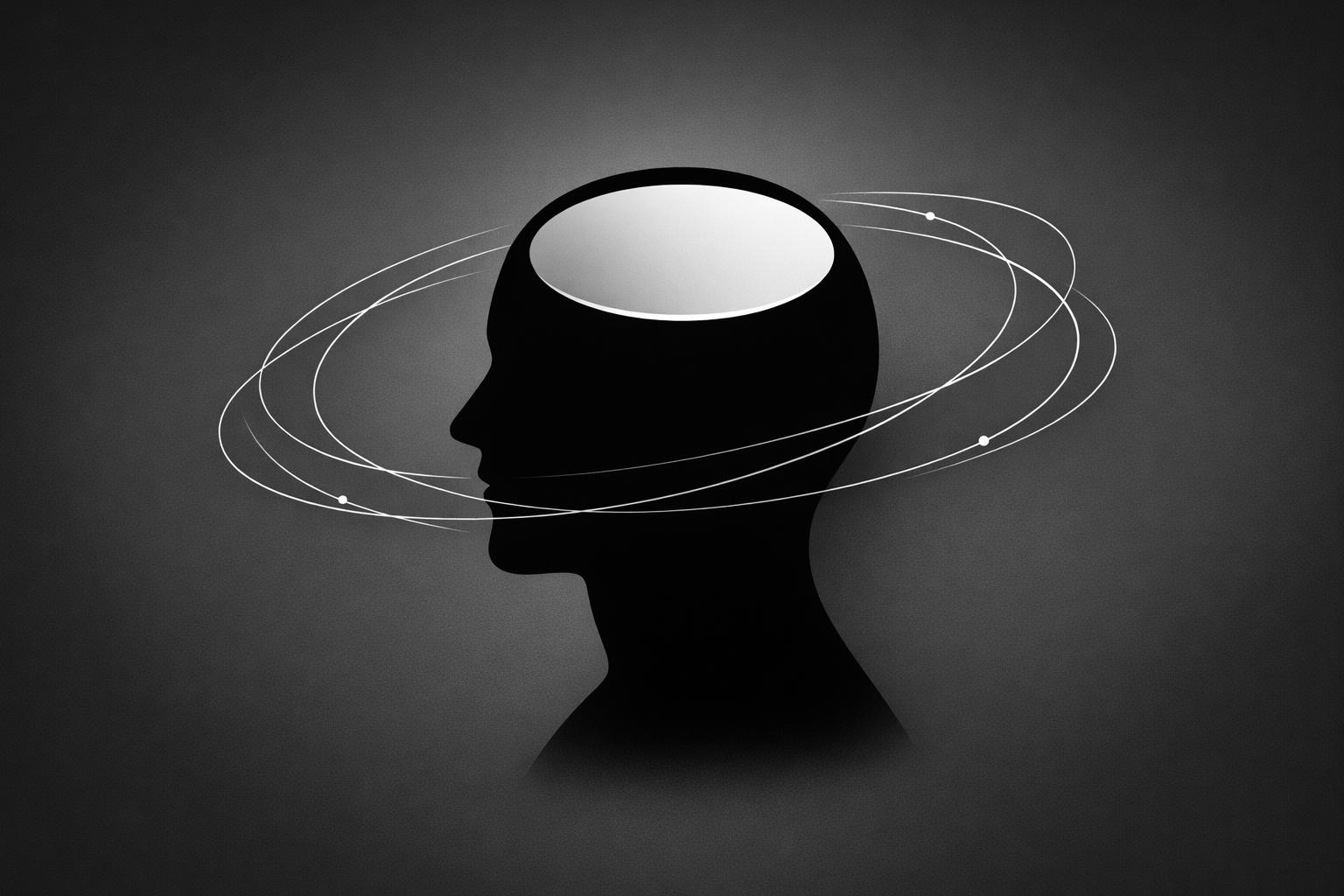
AI-generated content is everywhere, and while it can save time, it comes with hidden costs. Overexposure to this "cheap intelligence" can harm focus, memory, and critical thinking. Studies show that even minor distractions can take 23 minutes to recover from, and relying heavily on AI reduces brain activity in areas tied to learning. The polished responses AI provides may give a false sense of understanding, leaving you mentally fatigued and less resilient.
To combat this, the article suggests AI-assisted journaling as a tool to regain clarity. Apps like Pausa help you organize thoughts, identify patterns, and focus on what truly matters. By using daily and weekly recaps, you can filter out distractions, prioritize meaningful tasks, and even address unhealthy digital habits. Simple changes, like setting intentions before consuming content or scheduling focused time for important activities, can make a big difference.
Key Takeaways:
AI-generated content often feels useful but may hinder deep understanding.
Journaling with tools like Pausa helps declutter your mind and improve focus.
Regular reflections reveal patterns in your habits and guide actionable changes.
Prioritize intentional digital consumption and block time for what matters most.
This isn’t about rejecting AI but using it wisely to reclaim your mental space.
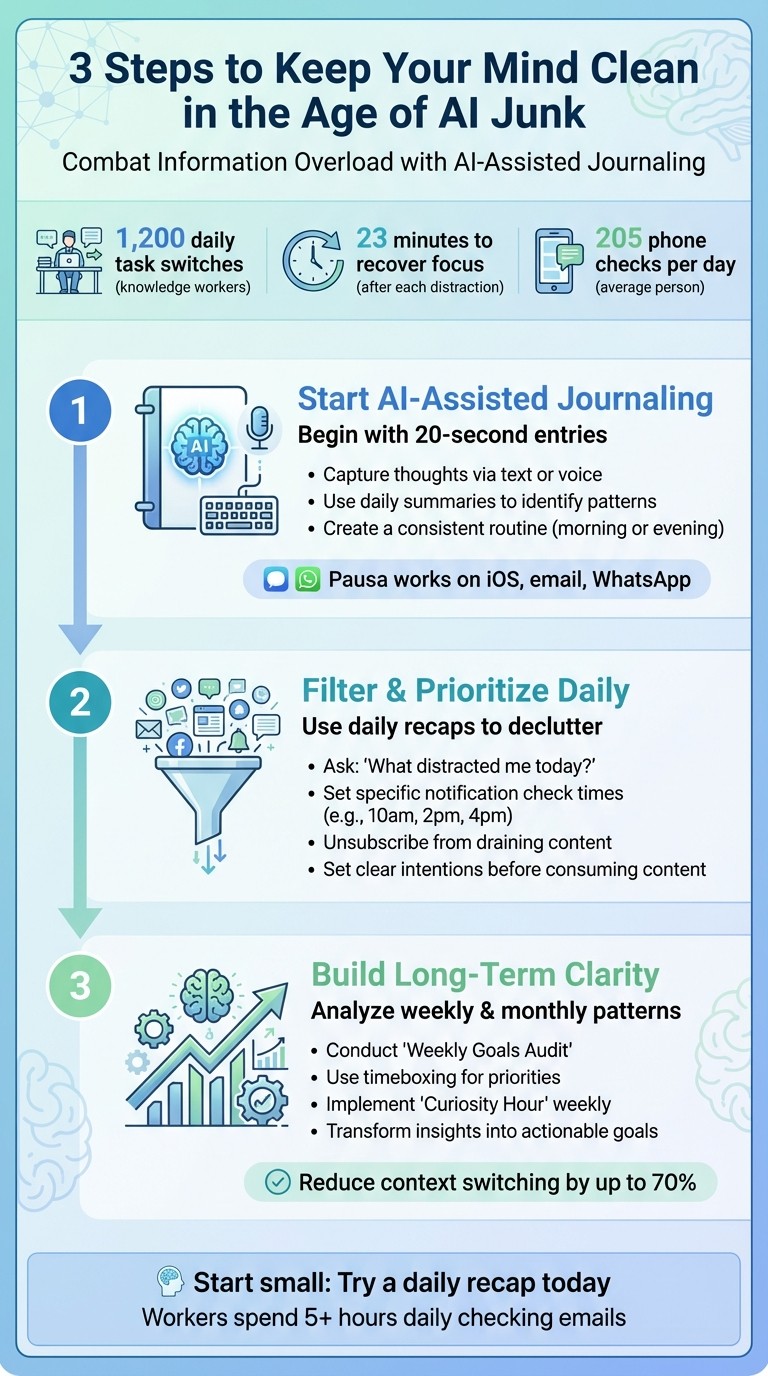
3-Step Guide to Mental Clarity Using AI-Assisted Journaling
How AI Junk Creates Mental Clutter
What Is AI Junk?
AI junk refers to repetitive, low-quality content generated by artificial intelligence. This can take many forms, from chatbot responses that sound polished but lack depth, to AI-generated articles that fail to provide meaningful insights. The real issue isn’t just its existence - it’s that this content often comes wrapped in a convincing veneer, making it hard to tell apart from genuinely useful information[3].
Lauren Richmond, a researcher at Stony Brook University, puts it succinctly: "AI is not necessarily making us stupid, but we may be interacting with it stupidly"[1]. When AI starts interpreting your feelings or offering conclusions, it essentially replaces personal thought with algorithm-driven suggestions. Unlike meaningful information that builds understanding, this kind of content can lead to a false sense of knowledge[2]. Its polished facade masks the cognitive risks it introduces.
The Mental Cost of Information Overload
Constant exposure to AI-generated content can take a toll on your cognitive abilities. For instance, knowledge workers reportedly switch between digital tasks nearly 1,200 times a day[6]. This relentless task-jumping is more than just a productivity killer - it leaves behind "attention residue", a mental lag that can impair focus for up to 23 minutes after each switch[6].
This cycle of digital multitasking contributes to what many experience as digital fatigue. Your prefrontal cortex has to work overtime to interpret text devoid of nonverbal cues, forcing your brain to fill in the blanks[6]. Add to this the fact that the average person checks their phone over 205 times per day[7], and the result is chronic mental strain. This isn’t just about feeling drained; it’s about losing the ability to deeply focus, think critically, and generate original ideas.
As innovation theorist John Nosta provocatively asks:
"If intelligence is no longer measured by the depth of our understanding but by the speed of our retrieval, are we truly expanding our cognitive potential - or simply surrendering to the illusion of knowing?"[3]
The consequences are far-reaching. Research from the Wharton School showed that students who relied on AI for math performed worse than their peers when the AI was removed. Similarly, brain-imaging studies at MIT revealed that students who used AI to assist with essay writing exhibited lower and less coherent brain activity compared to those who wrote independently[8]. Relying on AI doesn’t just save time - it offloads the mental effort that strengthens your cognitive abilities, leaving you with less mental resilience over time.
Step 1: Start AI-Assisted Journaling with Pausa
How AI Journaling Clears Your Mind
Traditional journaling often requires you to comb through your thoughts and figure out patterns on your own. With AI-assisted journaling, like Pausa, that burden is lifted. Pausa analyzes your entries to uncover recurring themes and thought patterns that might be adding to your mental clutter. It takes raw, unorganized reflections and turns them into structured insights you can actually use.
This process taps into your brain's default-mode network - the part of your mind responsible for self-reflection and decision-making. But don’t worry, it’s not thinking for you. Instead, it organizes your thoughts in a way that makes them easier to process. As Cornelia C. Walther, Ph.D., explains:
"AI's efficiency helps track tasks, but introspection determines whether they hold real meaning."[3]
With Pausa, fleeting ideas don’t have to slip away. You can quickly capture them through text or voice input, and the AI steps in to sort through what’s important and what’s just noise.
It even provides daily, weekly, and monthly summaries to give you a clear snapshot of your mental state. Beyond that, it suggests actionable steps to turn vague worries into tangible tasks. This isn’t about handing over your thinking - it’s about clearing out the mental clutter so you can focus on what truly matters.
Setting Up Your Pausa Routine
To get the most out of Pausa, start by building a simple routine. Begin with short, 20-second entries to jot down your thoughts without any pressure. Pausa works seamlessly across platforms like iOS, email, and WhatsApp, making it easy to journal wherever you feel comfortable. Choose a consistent time - whether it’s during your morning coffee or just before bed - and set a reminder. The key is sticking to a regular habit, not the length of your entries.
Before you start writing, create a small ritual to set the tone. Close any unnecessary tabs, mute your phone, or take a few deep breaths to signal to your brain that it’s time to reflect. Then, let it all out with a “thought dump” - write down everything on your mind without worrying about organization. Pausa’s AI will take care of sorting and prioritizing later, helping you see what’s urgent and what can wait. The free version includes basic text journaling and daily summaries, which is more than enough to get started.
Step 2: Filter and Prioritize Meaningful Information Daily
Using Pausa's Daily Recaps to Declutter
Pausa’s daily recaps are like a personal assistant for your mind, helping you cut through the noise of endless digital inputs. By organizing your thoughts into themes and patterns, the AI makes it easier to figure out what truly matters and what’s just background chatter. This process lays the foundation for refining how you engage with digital content every day.
Jumping between apps and tools all day can leave you mentally scattered. Pausa’s recap encourages you to reflect with questions like: "What distracted me today?" or "Which digital interactions felt genuine?"[3]
Here’s a practical tip: Separate the facts of any digital interaction from your assumptions, and then consider two alternative perspectives. Let’s say you spent an hour scrolling through news articles. Break it down - how much time did you actually spend, and what were your real motivations? Were you staying informed, procrastinating, or just chasing a dopamine boost? This simple exercise helps you clear the mental clutter by distinguishing reality from the stories you create around it.
Mindful Digital Consumption Habits
As you review your daily recaps, you’ll start to see patterns in your digital habits. Use this insight to fine-tune what you consume online. Think of it like managing your diet: unsubscribe from newsletters you never read, mute group chats that drain your energy, and unfollow accounts that spark outrage rather than genuine interest[11][4]. The goal isn’t to cut yourself off completely - it’s to quiet the flood of AI-driven content vying for your attention.
Studies suggest that checking notifications at set intervals can reduce stress and make you happier[12]. Try setting specific times - like 10:00 a.m., 2:00 p.m., and 4:00 p.m. - to check emails and messages[10][5]. During the rest of the day, stay focused on what your Pausa recap has highlighted as meaningful. As Nir Eyal, a productivity expert, wisely points out:
"You can't call something a distraction unless you know what it distracted you from."[5]
Your daily recap not only shows where your attention went but also whether it aligned with your priorities.
Before diving into an app or clicking a link, take a moment to pause and set a clear intention. Are you looking for specific information, completing a task, or just killing time? Defining your purpose can help you avoid endless scrolling and prevent digital clutter from piling up[9][6]. As you journal your day with Pausa, you’ll start to identify which digital habits help you thrive and which ones simply fill the gaps.
Step 3: Build Long-Term Mental Clarity with Pausa Insights
Spotting Patterns with Weekly and Monthly Recaps
Daily reflections give you quick insights, but Pausa's weekly and monthly recaps provide the broader perspective you need to spot trends in your digital habits. While your brain can only handle so much at once, Pausa steps in to analyze and present the bigger picture for you.
Think of these recaps as a "Weekly Goals Audit." They offer AI-generated summaries of your activities, which you can use offline to evaluate whether your tasks align with your core values and long-term goals[3]. Take Alicia, for example. In October 2025, as the Chief Marketing Officer of a midsize software company, she noticed recurring patterns of exhaustion in her reflections. By reviewing her 41 digital tools, she identified redundancies, streamlined her workflow, and cut down context switching by 70%, ultimately reclaiming nearly two hours of productivity each day[6]. Your own recaps could uncover similar opportunities - whether it’s reducing time spent in unproductive meetings or addressing reactive tasks that don’t contribute to meaningful progress.
Alvin Toffler captured this perfectly:
"The illiterate of the 21st century will not be those who cannot read and write, but those who cannot learn, unlearn, and relearn."[3]
Monthly recaps can also help you pinpoint outdated habits or mental models that need revisiting. For instance, maybe you still check your email first thing in the morning out of routine, even though your recaps show it disrupts your most productive hours. Use these insights to "unlearn" habits that no longer serve you, paving the way for meaningful change.
Turning Insights into Actionable Goals
Once you’ve identified patterns in your recaps, the next step is transforming those insights into concrete actions. Pausa's goal-tracking feature acts as a bridge between reflection and change. For example, if your recaps reveal that Wednesday afternoons consistently feel overwhelming, you could set a goal to block that time for focused work, silencing all notifications to protect your energy.
Timeboxing is another powerful tool to help you prioritize what matters most. Build your key priorities - whether it’s exercise, relationships, or creative projects - directly into your calendar as dedicated, non-negotiable slots[5]. If your monthly recap highlights that you’ve been skipping workouts or neglecting meaningful conversations with friends, schedule them as appointments. Studies show that regular social interaction releases oxytocin, which helps alleviate stress in ways no AI can replicate[3].
Consider implementing a "Curiosity Hour" each week. Use Pausa’s summaries of your interests as a starting point, then dive into one specific topic through independent reading or hands-on projects[3]. This practice shifts you from passively consuming AI-generated content to actively engaging with ideas, fostering deeper learning and expertise. Focused exploration like this not only sharpens your mind but also combats the mental fatigue that comes from endlessly skimming through information streams.
Future Proof Your Thinking (to Save Your Mind)
Conclusion: Take Control of Your Mental Space
In a world where digital distractions seem to grow louder every day, the power to reclaim your mental clarity lies in your hands. Recognizing the toll of endless AI-generated content on your focus is the first step. Tools like Pausa offer a simple yet effective way to regain control - helping you capture your thoughts in just 20 seconds, prioritize what truly matters, and transform daily reflections into actionable insights. Whether it's a quick journal entry or a thoughtful recap, each moment spent reflecting strengthens your ability to cut through the noise.
As Peter Walsh wisely put it: "Clutter isn't just the stuff on the floor. It's anything that gets between you and the life you want to be living" [13]. That clutter includes the constant barrage of digital distractions. With Pausa's daily, weekly, and monthly recaps, you're not just tidying up your thoughts - you’re creating a system that helps you identify patterns, eliminate unnecessary stressors, and focus on what truly drives you forward.
Start small. Try a daily recap or a weekly review and see the difference it makes. Consider this: workers spend over five hours a day checking emails, and every interruption can cost up to 23 minutes of focus [14]. Even minor changes can lead to a noticeable boost in mental clarity and productivity.
FAQs
How can AI-assisted journaling help improve mental clarity?
AI-assisted journaling brings a fresh approach to organizing your thoughts and gaining mental clarity. With tools like personalized prompts, emotion tagging, and automatic pattern recognition, it shifts your focus to meaningful reflection instead of struggling with what to write. This makes it easier to unload worries, process ideas, and declutter your mind.
By pinpointing recurring themes and summarizing past entries, these tools help you spot stress triggers and unhelpful thought patterns. The result? Less anxiety and a sharper ability to focus on what truly matters. In a fast-moving digital world, journaling with AI support transforms into a practical, daily habit for staying grounded and resilient.
What are the risks of relying too much on AI-generated content?
Relying too much on AI-generated content can take a toll on essential mental skills like reasoning, problem-solving, and creativity. This overdependence might lead to something called cognitive offloading, where tasks like memory and focus are handed over to machines. Over time, this can dull your natural abilities.
On top of that, excessive use of AI tools can expose you to risks such as misinformation, biased content, and flawed decision-making. It might also stifle deep thinking and originality, making it tougher to analyze and evaluate information thoroughly. The key to avoiding these challenges lies in finding the right balance - using AI as a tool while staying mentally engaged and sharp.
How can I set up a productive routine with Pausa?
To make the most out of Pausa, start your day with its AI-assisted journaling feature. Spend 5–10 minutes organizing your thoughts and setting a clear, focused tone for the day. This simple habit helps free your mind from clutter and prepares you to tackle the day ahead. You can also use Pausa’s AI filters to sift through digital content, ensuring that only the most relevant and meaningful information reaches you.
Incorporate 30-minute "AI-free" periods into your day to step away from technology. Use this time for offline tasks or reflective activities to maintain a healthy balance and avoid becoming overly dependent on AI tools. At the end of your day, take a moment to review what you’ve consumed. Use Pausa’s tools to highlight useful content for future reference and eliminate distractions. To keep things on track, conduct weekly reviews of your habits and adjust your filters as needed to stay aligned with your personal goals.
By following these steps, Pausa can help you declutter your mind, reduce digital noise, and focus on the things that truly matter.