
You Can’t Out-Create the Machine - So Create With Intention
Dec 24, 2025
Don’t race AI—use reflection and journaling to turn lived experience into purposeful creative work only humans can make.

Machines can generate massive amounts of content quickly, but they lack emotional depth, purpose, and the ability to reflect. Your strength lies in intentional creation - using your experiences, emotions, and personal insights to shape meaningful work. Instead of competing with AI's speed, focus on what it can't replicate: your unique perspective and ability to solve complex, nuanced problems.
Key takeaways:
AI excels at volume but lacks emotional depth and originality. For example, only 6% of AI-generated ideas in a study were unique.
Reflection is key to meaningful output. Pausing to think deeply helps refine ideas and ensures your work aligns with your goals.
Tools like Pausa support this process. They simplify journaling, identify patterns, and turn reflections into actionable steps.
In short, don’t try to outproduce AI. Instead, use tools and intentional practices to amplify what only you can bring to the table.
S17:E16: Why Intentional Storytelling Matters in an Era of AI and Algorithm-Driven Content
Why Intentional Creativity Beats Machine Output
AI can churn out content at incredible speeds, but it falls short in one critical area: it lacks the emotional depth and purpose that make creativity meaningful. Human creativity stems from emotions like curiosity, frustration, and inspiration - elements that AI simply cannot experience [6]. When you create something, it’s often driven by a desire to communicate, express, or solve a problem. AI doesn’t share that drive. As Francisco Tigre Moura from IU University of Applied Sciences explains, human intentionality involves "a conscious attempt to express genuine aspirations, emotions, and motives" [5] - something no algorithm can replicate.
The Limits of AI: Speed Without Purpose
AI has been described by researchers as a "stochastic parrot", capable of mimicking patterns from its training data but unable to grasp their emotional or creative depth [6][7]. A study led by Mack Institute research fellow Lennart Meincke highlighted this limitation. Participants using ChatGPT to come up with a toy idea repeatedly arrived at the same name: "Build-a-Breeze Castle." This lack of variety underscores how AI’s reliance on statistical patterns stifles creative diversity [8]. Christian Terwiesch, co-director of Wharton’s Mack Institute, pointed out that over-relying on ChatGPT results in a creative dead end because "the ideas are too similar to each other" [8].
This happens because AI tends to follow the "path of least resistance", favoring conventional data over bold, unconventional ideas [9]. In the same study, only 6% of AI-generated ideas were considered unique, compared to 100% uniqueness in human-only creations [8]. While AI can produce content in bulk, it avoids the risks that often lead to groundbreaking ideas [7][10].
The Role of Reflection in Meaningful Creation
These shortcomings make one thing clear: meaningful creativity requires deep, reflective thought. What sets intentional creativity apart from machine output is the ability to pause, think deeply, and refine ideas. AI tools are most effective when they support this reflective process rather than trying to replace it. As MIT Technology Review puts it, "Reflection is a particular type of focused, deliberate thinking... It's the opposite of a one-shot interaction" [1].
To tap into your unique creativity, intentional reflection is key. Tools like Pausa can help capture your thoughts quickly and reveal patterns you might not notice otherwise. By letting AI handle repetitive tasks, you create more mental space for higher-level thinking [2][4]. The goal is to use AI to amplify your voice, not replace it. As Moura emphasizes, maintaining an "expression of motives and intent" is essential [5]. Your lived experiences, emotional insights, and ability to navigate complex situations remain unmatched by any algorithm.
Step 1: Capture Your Thoughts Quickly with Pausa
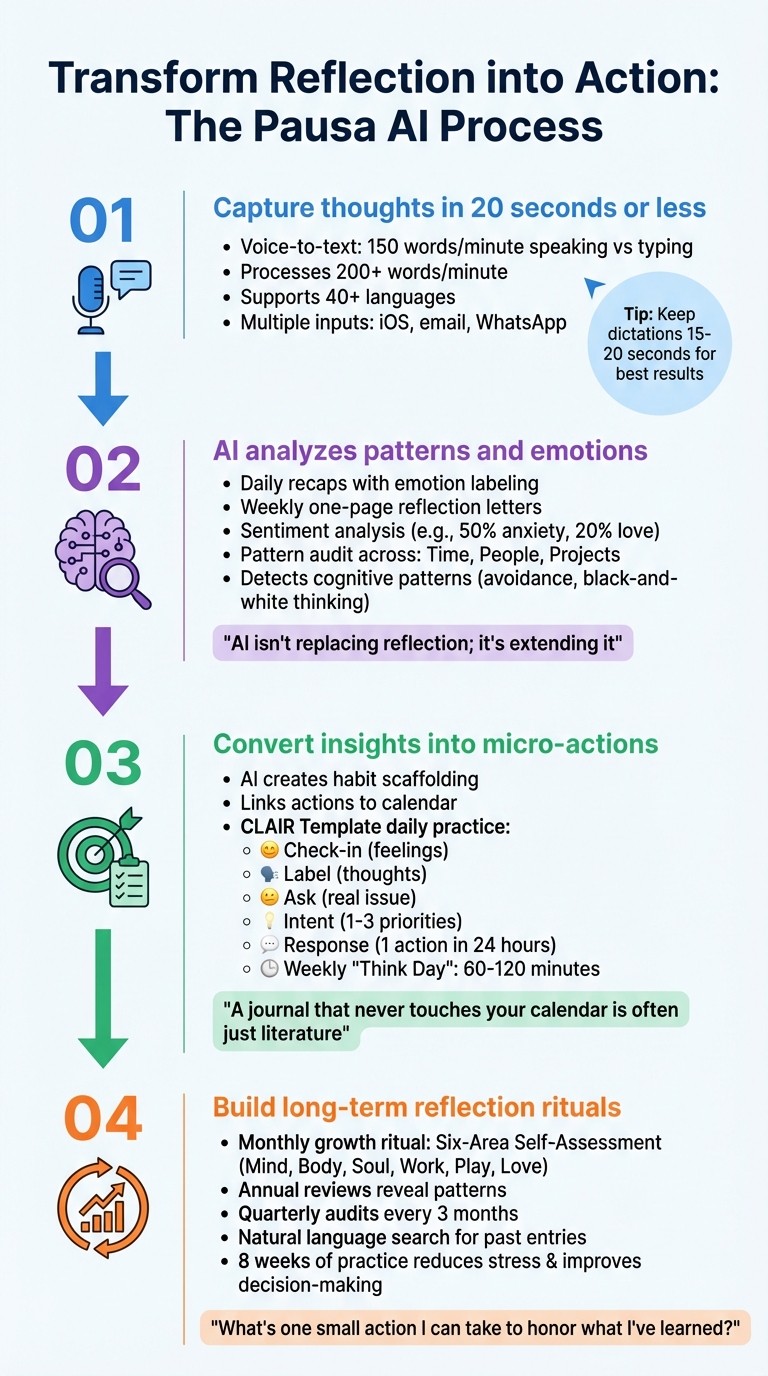
4-Step Process for Intentional Creation with Pausa AI Journaling
Learning how to start digital journaling can feel like a daunting task. Often, it's not about uncovering profound insights but simply overcoming the challenge of starting. That blank page can feel intimidating, creating what some describe as an "emotional low point" that stops people in their tracks[11]. This is where Pausa comes in. It allows you to jot down your thoughts in 20 seconds or less, no matter where you are - on your commute, taking a walk, or winding down for the night. The goal isn’t to craft perfect entries; it’s to catch those fleeting ideas before they vanish. By doing this, you lay the groundwork for Pausa’s powerful voice-to-text tools.
Using Voice-to-Text for Natural Expression
Talking often feels more natural than typing. With Pausa, you can speak your thoughts at a pace of about 150 words per minute - much quicker than typing - and let its AI handle the rest. It cleans up filler words and transforms your speech into clear, organized sentences[11][13][14]. The technology is impressive, processing over 200 words per minute and supporting more than 40 languages[12][14]. For the best results, keep your dictations short - 15 to 20 seconds at a time[14]. And here’s a pro tip: avoid staring at the screen as you speak. This helps you stay in the moment and maintain your creative flow[13].
Multiple Input Options for Any Moment
Pausa adapts to your lifestyle. Whether you’re on a lunch break, enjoying a walk, or getting ready for bed, you can capture your thoughts instantly through iOS, email, or even WhatsApp. This flexibility means you don’t have to wait for the perfect time or fiddle with specific apps. The key to success is consistency - write when inspiration strikes, wherever you are.
Step 2: Turn Entries into Insights with Pausa AI
Jotting down your thoughts is just the beginning. The real magic happens when you can spot the patterns in your life that you’ve never quite been able to name. Pausa AI takes your entries and analyzes them, uncovering recurring triggers, emotional trends, and even mismatches between your values and actions. Think of it as taking your reflection to the next level. As one analysis puts it:
AI isn't replacing reflection; it's extending it. Where traditional journaling captures moments, AI connects them. [16]
This process sets the foundation for daily and weekly summaries that bring even more clarity to your self-discovery journey.
Daily and Weekly Recaps for Better Understanding
Pausa provides daily recaps that break down your entries, label your emotions, and pinpoint what worked well versus what could use improvement. It’s like holding up a mirror to your thoughts, revealing the details you might have overlooked. At the end of the week, you’ll receive a one-page "reflection letter" that lays out your insights in a clear, actionable format.
The AI even quantifies your emotional state. For example, sentiment analysis might show that a particular entry is 50% anxiety and 20% love [15]. It’s not about reducing your feelings to mere numbers - it’s about offering clarity through data when your emotions feel too tangled to sort out.
But Pausa doesn’t stop at summaries; it dives deeper into the underlying patterns shaping your life.
Recognizing Patterns and Themes with AI
Pausa’s AI can detect cognitive patterns like "avoidance flags" or black-and-white thinking - things that are tough to notice on your own. In experimental trials, AI models have analyzed over 600 personal entries, uncovering recurring relationship dynamics and stalled goals [16]. For instance, a frequent use of the word "should" might signal perfectionist tendencies [17].
The AI performs what’s called a pattern audit, examining your entries through three key perspectives:
Time: Do your emotions shift between weekdays and weekends?
People: Does your tone change when certain names come up?
Projects: Are there efforts you’ve been writing about for months without making progress?
Licensed therapist Sergio Rodriguez Castillo highlights the value of this approach:
[AI journaling] strikes a rare balance - offering support with gentle nudges and thoughtful invitations to reflect. [16]
The aim isn’t to tell you what to think. Instead, it’s about helping you recognize what you’ve been missing all along.
Step 3: Transform Reflections into Actionable Goals
Understanding your patterns is just the beginning. The real change happens when you turn those reflections into actionable steps. Without action, insights remain little more than fleeting thoughts. That’s where Pausa’s AI-driven tools come into play, helping you bridge the gap between reflection and meaningful progress.
From Reflection to Action with Suggested To-Dos
Pausa leverages AI to create "habit scaffolding" - a system of micro-actions, deadlines, and accountability check-ins based on your journal entries [16]. For example, if your entries reveal a recurring pattern like "procrastination + guilt", Pausa might suggest starting a challenging task with just five minutes of effort, seamlessly linking this action to your calendar [16].
This process follows what Pausa calls the "AI-Journaling Loop." It begins with raw reflections, tags emerging patterns, and then designs small experiments to encourage new behaviors. For instance, if your journaling highlights an issue like excessive phone use in the bedroom, Pausa might propose a micro-experiment to limit screen time in that space [16][17]. Or, if you’ve been stuck on a project for months, the system could prompt you to define a constraint, identify a specific behavior to focus on, and set a measurable goal to track over the next week [16].
As Daniel W. Chen, Founder of Life Note, aptly states:
A journal that never touches your calendar is often just literature. [18]
After reflecting with AI-assisted tools, ask yourself, “What’s one small action I can take to honor what I’ve learned?” This question transforms deep insights into practical steps, naturally evolving into habits that support long-term growth.
Building Habits with Goal Tracking
Once you’ve turned your reflections into micro-actions, Pausa’s goal-tracking features help you solidify these changes into lasting habits. Acting as a "second mind", the tool analyzes recurring themes in your journal entries to pinpoint the disconnect between your values and actual behaviors [16]. Research supports this approach, showing that setting clear, meaningful goals activates the brain’s reward system, increasing both motivation and productivity [3].
Take, for example, YouTube creator @ThatJournalingGuy. By analyzing over 600 journal entries and two years of time-tracking data with an AI assistant, he uncovered blind spots - such as a tendency to rely on external validation. This newfound awareness ultimately led him to pivot his career toward AI development [16].
To stay on track, try using the CLAIR Template each day:
Check-in: Identify your current feelings.
Label: Note what your mind is saying.
Ask: Pose a question to uncover the real issue.
Intent: Set 1–3 key priorities.
Response: Commit to one specific action within the next 24 hours [18].
Additionally, dedicate 60–120 minutes weekly to a "Think Day." Use this time to review what energized or drained you, generate a one-page summary with AI, and schedule the one step that can make the biggest impact on your goals [18]. Since the brain tends to forget most daily experiences, a digital journal becomes an essential tool for tracking and fostering long-term growth [18].
Step 4: Create Rituals for Long-Term Growth
Daily habits are great for building momentum, but long-term rituals are where true growth takes shape. These rituals allow you to step back and see the bigger picture - patterns and trends that individual days can’t reveal. That’s where Pausa’s recap features come into play. They don’t just help you track what’s happening; they help you understand who you’re becoming over time.
Using Monthly and Annual Recaps for Reflection
Pausa’s AI tools analyze your journal entries to uncover monthly mood trends and highlight gaps between your values and actions. These insights go beyond surface-level reflection, showing how your self-perception evolves alongside your emotions and experiences [16].
Start by establishing a monthly growth ritual. Dedicate time to review Pausa’s AI-generated summary of the past month. Use tools like the Six-Area Self-Assessment to evaluate how you’re doing across six key areas: Mind (clarity), Body (health), Soul (connection), Work (fulfillment), Play (joy), and Love (relationships) [19]. You can also ask Pausa to identify your top five sources of joy and your top five energy drains, creating what’s called a "neutral life map" [16].
For a deeper perspective, annual reflections are key. Look back at your monthly reports to uncover patterns and themes that might have gone unnoticed. For example, if you notice that 70% of your entries include the word "should", it could point to a recurring perfectionism issue [17]. These annual reviews are like a high-level map of your emotional and creative journey.
Science supports this kind of reflection. Research shows that just eight weeks of consistent mindfulness practice can reduce stress (by calming your brain’s amygdala) and improve decision-making by strengthening the prefrontal cortex [19]. These rituals don’t just help you reflect - they can literally reshape how your brain processes challenges.
Revisiting Past Entries with New Perspectives
Beyond monthly and annual reviews, revisiting older entries can be a powerful way to see how far you’ve come. Your journal isn’t just a record of what happened; it’s a tool to uncover new insights. With Pausa’s natural language search, you can ask targeted questions like, “When did I feel proud last year?” or “What emotional themes showed up this month?” [19]. This transforms old notes into a treasure trove of fresh perspectives.
As Søren Kierkegaard famously said:
Life can only be understood backwards; but it must be lived forwards [19].
Looking back at entries from three or six months ago can reveal things you couldn’t see at the time. For instance, you might realize that a problem you stressed over in March resolved itself by June, or that a small choice in January led to a big win months later.
Consider doing quarterly audits every three months. Review tagged entries and AI-generated "theme timelines" to see how your personal narrative has shifted [17]. Let Pausa’s AI prompts guide you in designing small experiments based on what you’ve learned. For example, if your entries show that excessive phone use in the bedroom is a recurring issue, set a one-week challenge to limit screen time in that space. Then, during your next recap, check if the change felt easier to sustain [16].
“AI isn’t replacing reflection; it’s extending it. Where traditional journaling captures moments, AI connects them.” – ThatJournalingGuy, Content Creator [16]
Finally, ask yourself: "What’s one small action I can take to honor what I’ve learned?" This simple step ensures your reflections don’t stay confined to the page - they become the foundation for intentional, meaningful growth.
Conclusion
You can't outpace a machine when it comes to speed or sheer volume. AI excels in those areas. But your strength? It lies in intentionality. As K.M. Weiland so eloquently puts it:
To write with intention is to choose meaning over ease, depth over noise, and wholeness over quick results. It's an act of quiet rebellion in a culture of speed and automation [20].
The landscape is already shifting. Studies reveal that while AI can boost the novelty of creative work by 8.1%, it also increases content similarity by up to 10.7% [21]. And that’s the catch: AI raises the baseline quality, but it compresses the range of originality. Your competitive edge isn’t in mimicking machines - it’s in expressing what only you can bring to the table.
As we've explored, intentional creativity is your unique superpower in this AI-driven world. Tools like Pausa harness this power by transforming reflective journaling into actionable growth. It captures your thoughts in moments, uncovers patterns over time, and helps you turn reflection into meaningful action. With Pausa, you can better understand your story, clarify your priorities, and build habits that align your actions with what truly matters to you.
This alignment - where intention meets action - is where your creative advantage shines. As John Nosta puts it, real intelligence comes from grappling with complexity [3]. Pausa provides the space to do just that: to reflect, to wrestle with ideas, and to create with purpose. Not to race against AI, but to craft something that’s meaningful to you.
Your journey toward intentional creativity begins with a single thought. Make it one that matters.
FAQs
How can I stay creative and authentic in a world dominated by AI?
To keep your creative work genuine, think of AI as a tool that complements your efforts rather than taking over. Start by identifying your goal - what specific story, emotion, or idea do you want to bring to life? With this clear purpose in mind, you can use AI-generated content as a foundation, refining it with your own perspective and style to preserve your unique voice.
AI can take care of the tedious tasks, like organizing your thoughts or handling formatting, freeing you up to focus on what truly matters - crafting compelling stories, conveying emotion, and adding depth. Many creators find that this balance not only enhances productivity but also helps them stay aligned with their personal style.
To further cultivate your individuality, build habits that support your creative identity. Consider using an AI-assisted journal to reflect on your process, set limits on how much AI content you incorporate, and revisit your past work to uncover the patterns that define your voice. By being intentional and selective, you can transform AI into a valuable partner for creating meaningful and purpose-driven work.
How does reflection improve my creative process when using AI tools?
Reflection plays a crucial role in transforming raw ideas into meaningful creations. Taking a moment to assess what feels both original and worthwhile allows you to move beyond merely accepting AI-generated suggestions as they come. This deliberate pause empowers you to shape ideas that truly align with your goals, positioning you as a co-creator rather than just an editor of AI's output.
When paired with AI-driven tools like journaling apps, reflection turns the technology into a supportive companion rather than a substitute. While AI can identify patterns, suggest prompts, or help organize your thoughts, it’s your reflective input that brings depth and direction to those ideas. In this partnership, AI doesn’t overshadow your creativity - it enhances it, amplifying your unique voice in the process.
How can I use Pausa to enhance my creativity with intention?
To get the most out of Pausa for your creative pursuits, start by defining a specific goal for your session. Whether you’re brainstorming ideas for a blog post or reflecting on a personal experience, having a clear purpose will help you stay focused and intentional.
Let Pausa provide prompts or spark ideas, but think of its suggestions as just the beginning. Use them as a springboard for your own thoughts, adding your perspective and refining the ideas through reflective journaling. This back-and-forth process can deepen your creative expression and ensure your work feels genuine.
When you’ve developed your ideas, take a step back and review your work without relying on AI. Give yourself a moment to pause, then revisit your notes with fresh eyes to polish and shape them independently. By blending AI’s input with your own insights, you can create work that feels both meaningful and aligned with your vision.