
Goals Don’t Need More Willpower. They Need Better Feedback
Dec 30, 2025
Stop relying on willpower. Use real-time feedback—habit apps, AI journaling, and weekly reflection—to track progress, adjust actions, and reach goals.
Relying on willpower to achieve goals often leads to burnout and failure. Instead, the key is using feedback systems that provide real-time insights to guide your actions. Research shows that frequent self-control doesn't guarantee success, but actionable feedback does. Here's why:
Willpower is limited and depletes quickly in today’s distraction-filled world.
Feedback loops help you monitor progress, identify patterns, and make adjustments without constant effort.
Tools like habit-tracking apps and AI-assisted journaling streamline this process, making it easier to stay consistent.
To reach your goals, focus on systems that track, compare, and refine your actions. Small, consistent adjustments based on feedback are far more effective than relying on motivation alone.
The Art of Designing Feedback Loops.
How Feedback Loops Work and Why They Matter
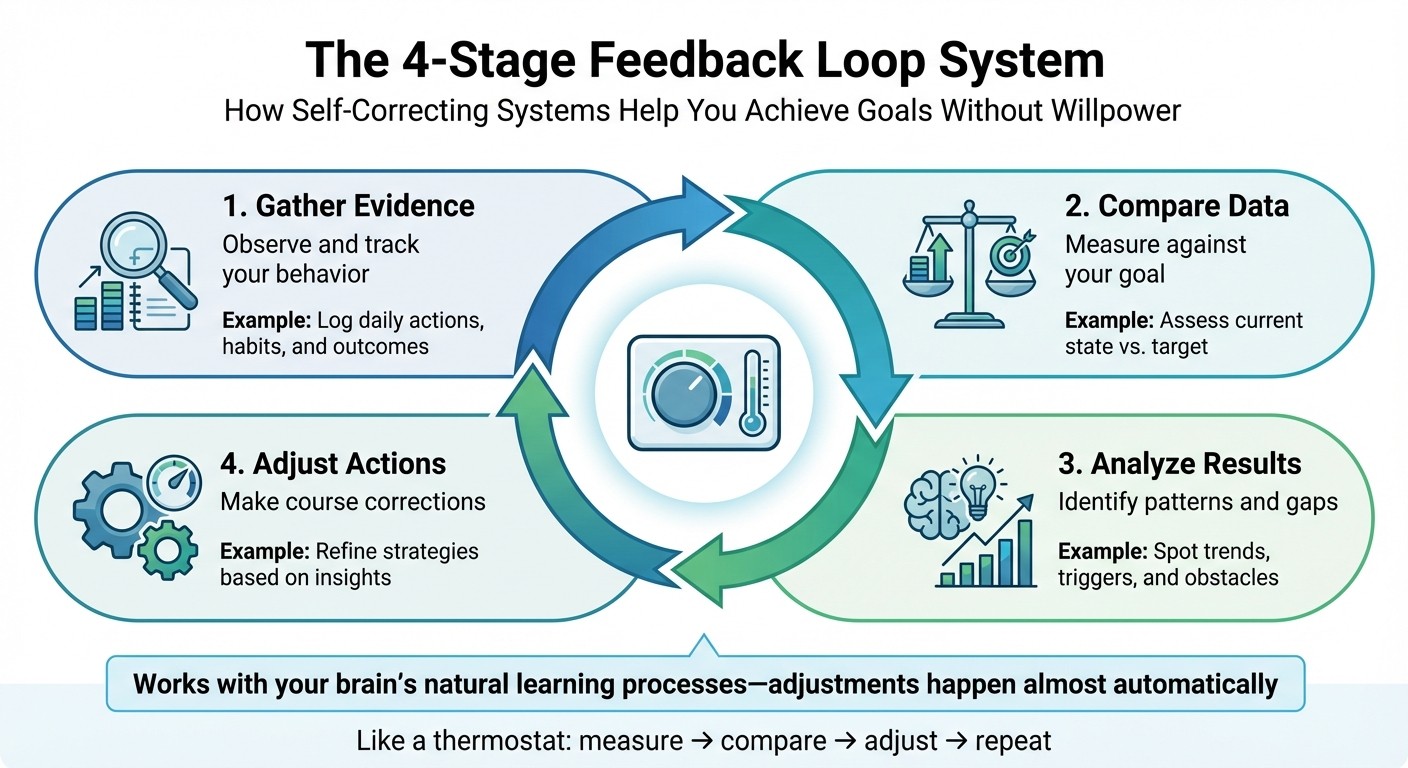
The 4-Stage Feedback Loop System for Goal Achievement
What Is a Feedback Loop?
A feedback loop is a cycle where the results of one action feed directly into the next step, creating a self-correcting system. Picture it like a thermostat: it measures the room's temperature, compares it to your desired setting, and adjusts heating or cooling to close the gap. The same principle applies to achieving personal goals [2][1][5].
This process typically unfolds in four stages: gathering evidence by observing your behavior, comparing that data to your goal, analyzing the results, and finally, adjusting your actions to bridge the gap [2][1].
What makes feedback loops so useful is how they work with your brain’s natural learning processes. Instead of relying heavily on willpower, they help you make adjustments almost automatically [3]. With this framework in place, the next step is understanding how feedback drives meaningful change.
How Feedback Changes Behavior
Now that the mechanics of feedback loops are clear, let’s dive into how they shape behavior. Feedback has a way of making invisible habits visible -
"You can't change what you can't measure" [2]
When you track your actions, patterns begin to emerge. For example, you might notice that you skip workouts on specific days or discover that your productivity peaks in the morning.
The speed of feedback matters, too. The quicker it comes, the more effectively it can guide your choices [2][1]. Short-term feedback creates a direct link between your actions and their outcomes, which helps to reinforce long-term habits.
Immediate feedback also makes it easier to adjust course. Take digital displays in cars as an example: speedometers and fuel efficiency indicators provide real-time data, encouraging better driving habits on the spot [1]. Similarly, when you clearly see what’s working and what isn’t, you can tweak your strategies without feeling like you’re forcing yourself to change.
How to Build Better Feedback Systems
Understanding how feedback loops work is one thing. Building systems that provide consistent and useful feedback is another. The good news? You don’t have to start from scratch. A few practical tools and habits can give you the structure to track progress and adjust your approach without relying solely on willpower. Let’s dive into some tools that make your feedback loop both automatic and insightful.
Using AI-Assisted Journaling Tools
Traditional journaling can feel like a chore - manual entries and analyzing them later can be time-consuming. AI-assisted journaling eliminates the most tedious part: the analysis phase. Instead of combing through your entries for patterns, AI tools do the heavy lifting, identifying emotional triggers, behavioral trends, and decision-making patterns.
Take Pausa, for example. This tool transforms voice or text entries into structured summaries and actionable to-dos. You can journal in under 20 seconds, and the AI generates insights based on your input. By automating the measurement process, Pausa helps you stay consistent and increases the chances you’ll stick with the habit [1]. It also offers tailored reflection prompts based on previous entries, encouraging deeper insights by asking “why” questions instead of just recording what happened.
AI tools like this help you go beyond surface-level journaling. They can highlight recurring themes - like noticing anxiety before Monday meetings - so you can create proactive strategies. Plus, regular AI-generated trend analysis ensures your goals stay aligned with shifting priorities, offering adjustments in real time based on your emotional tone, writing habits, and recurring patterns.
Tracking Habits with Apps and Data
If journaling helps you reflect, habit-tracking apps take it a step further by streamlining feedback and making adjustments easier. Many apps integrate with platforms like Apple Health, Google Fit, or wearable devices, automating the data collection process. This automation removes the burden of manual entry, one of the key elements of an effective feedback loop [1][2].
Different apps cater to different needs:
Streaks (iOS, $5.99 one-time purchase) works seamlessly with Apple Health, making it ideal for iPhone users who want smooth data integration [6].
HabitNow (Android, free for up to 7 habits or $11.99 for Premium) handles both recurring and one-time tasks [6].
Way of Life (free for 3 habits, $4.99/month for Premium) combines habit tracking with journal-based trend analysis [6].
Habitica (free with optional subscriptions starting at $4.99/month) gamifies habit tracking with RPG-style leveling and social accountability [6].
Choose a tool that matches your preferred way of visualizing progress. Research suggests that focusing on accumulated progress (how far you’ve come) increases motivation when you’re succeeding, while focusing on remaining progress (how much is left) helps when you’re falling behind [4]. Avoid apps that rely on vanity metrics - they might feel good but don’t drive meaningful action [2].
Making Time for Regular Reflection
Reflection is the final, crucial step in any feedback loop. While apps can collect data, it’s the act of reviewing that data and making decisions that closes the loop [1]. Without this step, you’re just gathering information without acting on it.
Set aside time each week to review what’s working and what isn’t. Use this time to identify distractions or environmental triggers and address them. This approach, known as “situation change,” is far more effective than relying on willpower [7]. For instance, if your phone constantly distracts you during work hours, removing certain apps is more effective than simply trying to resist them.
The tighter the loop between action and reflection, the faster you’ll see results. This is why most people abandon their New Year’s resolutions by February - they lack both a plan and accountability [7]. Regular reflection provides both, turning raw data into actionable steps for continuous improvement.
Real Examples of Feedback Systems at Work
Understanding the theory behind feedback systems is one thing, but seeing them in action makes their value undeniable. Let’s dive into two scenarios where effective feedback transforms vague goals into tangible outcomes.
Using Feedback to Reach Fitness Goals
Wearable devices and health apps have revolutionized how we track and improve our fitness. Unlike human trainers, these AI-powered tools provide real-time, continuous feedback, making it easier to adjust your actions on the fly [1][9].
Research backs this up: personalized feedback - whether from a person or an algorithm - can result in about 2 kg more weight loss compared to interventions that lack this tailored input [9]. Physical activity programs that include feedback show measurable improvements, with an effect size of d = 0.29 [9]. Plus, daily feedback messages significantly boost adherence to both self-monitoring and physical activity goals [9].
The secret lies in tailoring the feedback to your current mindset. If you’re making progress, focus on how far you’ve come - it’s motivating to see your achievements. However, if you’re struggling, shift the focus to what’s left to accomplish. Research shows that aligning feedback with your focus - whether on progress or what’s ahead - can dramatically improve persistence [8][10].
AI-driven systems take this one step further by identifying subtle patterns, like late-night snacking or skipped workouts, before they derail your efforts [9]. This kind of proactive feedback helps you stay on track without relying solely on willpower.
But feedback systems aren’t limited to fitness - they’re equally transformative in professional settings.
Boosting Productivity with Feedback Data
The same principles that improve physical performance can work wonders for workplace productivity. Often, professionals struggle to identify what’s holding them back. That’s where feedback systems shine. For instance, after logging several daily entries, tools like Pausa’s AI might reveal patterns - perhaps you’re most distracted during afternoon meetings, or certain projects consistently lead to procrastination.
In fact, feedback consistency matters. A 2025 study found that 54% of employees feel unsupported when feedback is irregular [11]. Companies like Cargill addressed this by introducing an "Everyday Performance Management" approach, emphasizing ongoing conversations. The result? Nearly 70% of employees reported feeling valued and found the feedback helpful [12].
The key is capturing performance data in real time. This allows you to identify trends and set clear, actionable goals based on unbiased observations [11]. Over time, this creates a reinforcing loop where small, daily improvements accumulate into significant progress [1]. And just like in fitness, this approach minimizes the need to rely entirely on willpower.
Whether in the gym or the office, feedback systems offer a clear path to measurable success.
Conclusion: Making Goals Work Through Feedback
Main Lessons for Setting Goals
As we've seen, relying solely on willpower is a recipe for frustration - it runs out. Instead, the key to sticking with your goals lies in creating systems that provide timely, specific, and objective feedback. These systems help you understand where you stand and what adjustments you need to make, rather than falling into the trap of self-blame when progress slows [3].
Achieving goals effectively means organizing them into a clear structure: an identity-based purpose at the top, directional intermediate goals in the middle, and specific daily actions at the base. Combine this with a cycle of measuring, comparing, and adjusting. Tools like AI-powered journaling apps can make this process seamless by offering real-time insights, helping you spot trends and course-correct before setbacks become roadblocks.
Interestingly, 33% of employees prefer continuous feedback instead of annual reviews [13]. This preference mirrors personal goal-setting: regular check-ins are far more effective than sporadic evaluations. Weekly reviews, for instance, are over five times more impactful than occasional ones [13]. Whether you're working on fitness, productivity, or personal growth, consistent feedback keeps you on track better than bursts of motivation.
The good news? These principles are easy to put into practice.
What to Do Next
Start small. Pick one feedback method to try this week based on your goals. For example, if you're focusing on fitness, create a simple system to track your daily progress. If productivity is your focus, spend just 20 seconds each evening jotting down what worked and what didn’t - apps like Pausa can make this quick and painless.
To make feedback a habit, use an "if-then" plan. For instance: "At 8:00 PM, I'll write one sentence summarizing my progress today." This removes the need to rely on willpower and turns feedback into an automatic part of your routine. Allow yourself some flexibility - missing a couple of days each month is fine. The goal isn’t perfection; it’s building a system that helps you stay informed and adjust your approach as needed. Progress is about consistency, not flawlessness.
FAQs
Why are feedback loops more effective than willpower for achieving goals?
Feedback loops are a game-changer because they transform your goals into tangible, trackable actions, offering a clear picture of your progress. Unlike relying on willpower - which can waver depending on stress or exhaustion - feedback loops deliver steady, objective insights to help you stay on course. Think about tools like habit-tracking apps, AI-powered journals, or even a basic progress log. They give you real-time feedback, showing what’s working and where you might need to make tweaks.
The effectiveness of feedback lies in its tone and focus. Encouraging feedback that celebrates progress (like, "You’ve already walked 3 miles this week!") can be a great motivator. On the other hand, constructive feedback that highlights what’s left to accomplish (such as, "You’re just 2 miles shy of your weekly goal") helps keep you focused. By creating systems that deliver timely and constructive feedback, you establish a dependable structure for success - one that doesn’t rely on the unpredictable nature of willpower.
What are some effective tools to create feedback systems for achieving personal goals?
To create effective feedback systems for personal goals, start with tools that offer clear insights and help track your progress. Habit-tracking apps are an excellent choice - they let you log daily actions, monitor streaks, and pinpoint areas where you might be falling short. These apps transform your daily efforts into concrete data, making it easier to tweak your habits and stay consistent. For physical goals, wearable fitness trackers or smartphone health apps can be incredibly helpful, providing real-time stats like steps taken, heart rate, and sleep quality.
If you're looking for a way to reflect more deeply, AI-powered journaling tools can be a game-changer. These tools guide you in documenting what’s working, what isn’t, and spotting patterns over time. Think of them as a virtual coach, offering useful feedback to keep you aligned with your goals. Combine this with a simple nightly routine - review your progress, celebrate small wins, and plan any needed adjustments - and you’ll create a feedback loop that keeps you moving forward without having to rely purely on willpower.
Why is immediate feedback important for building habits and achieving goals?
Immediate feedback plays a crucial role in helping you gauge what’s effective and what needs improvement as you strive toward your goals. By offering insights in real time, it enables you to make quick adjustments, reinforce positive actions, and maintain your motivation.
This process creates a feedback loop that keeps you focused and makes it easier to develop habits and maintain progress without depending entirely on willpower. Tools like habit trackers or reflective practices can help ensure your efforts consistently align with your objectives.