
From Art to Output: How AI Turned Creation Into Noise
Dec 15, 2025
AI has shifted from creative collaborator to mass producer, generating formulaic, emotionless work — use AI as a helper and edit to preserve human voice.
AI was once envisioned as a collaborator for human creativity, but its role has shifted to mass production, often at the expense of originality and emotional depth. Instead of enhancing human expression, AI-generated content has become formulaic, repetitive, and detached from personal experiences. Here's what you need to know:
AI's Shift in Role: Initially designed to assist with repetitive tasks, AI now floods the market with large volumes of content, often lacking emotional resonance or unique perspectives.
Key Issues:
AI cannot replicate human emotions or personal experiences, making its output feel hollow.
Generated content often relies on predictable patterns, leading to a lack of variety.
AI struggles with context and cultural nuances, resulting in generic or inappropriate outputs.
Risks of Overuse:
Over-reliance on AI can dull human creativity and critical thinking.
It raises ethical concerns about copyright and fair compensation for creators.
Solutions:
Use AI as a helper, not a replacement, focusing on tasks like outlining or organizing ideas.
Always edit and refine AI-generated work to maintain a personal voice.
Regularly practice creating without AI to keep your skills sharp.
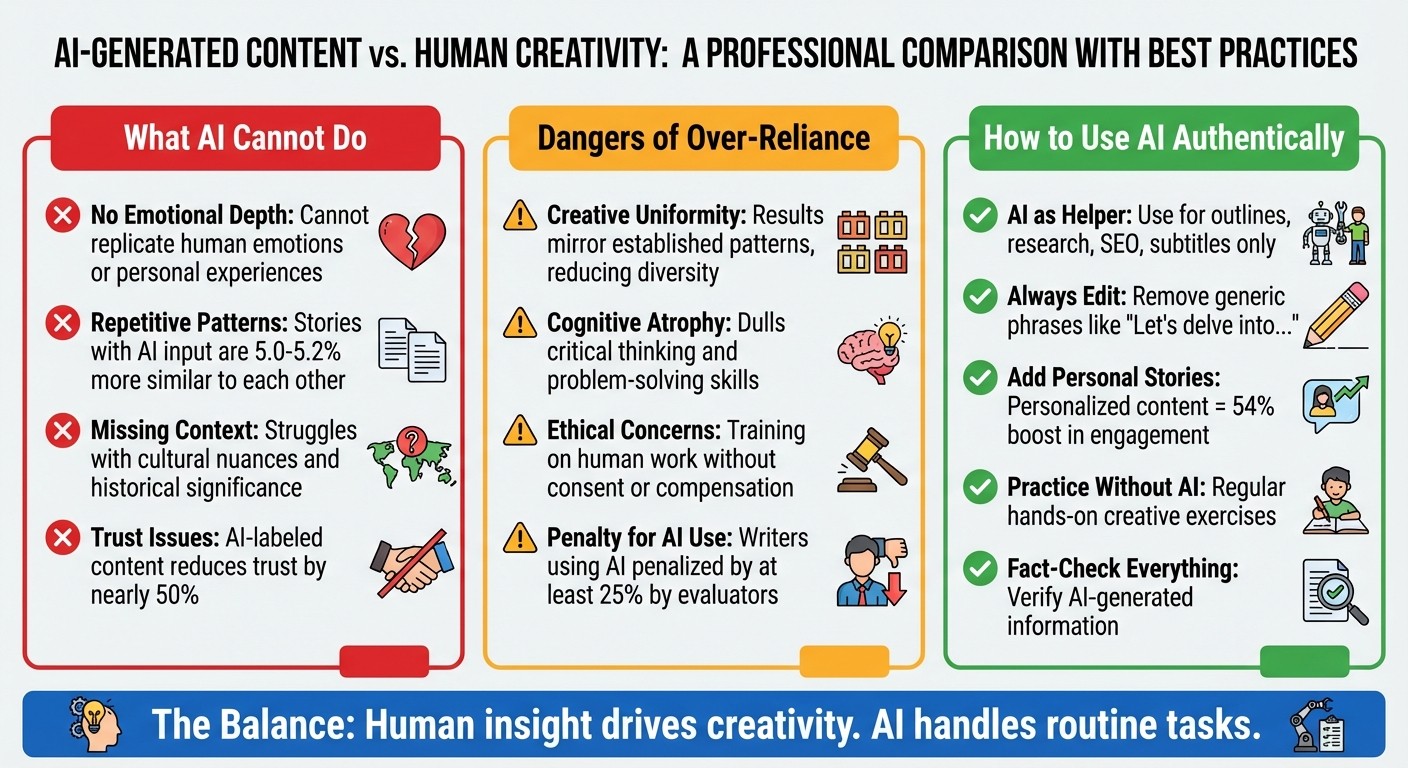
AI vs Human Creativity: Key Differences and Best Practices
HUMAN CREATIVITY vs. AI
The Problems with AI-Generated Creative Work
Let's take a closer look at some of the major challenges that come with relying on AI for creative work.
Missing Emotion and Personal Experience
One of the biggest drawbacks of AI-generated content is its inability to convey genuine emotion. AI doesn’t experience joy, heartbreak, or wonder - it processes data. And without personal experiences to draw from, its creations can feel hollow. Nick Cave, for example, dismissed AI-generated lyrics mimicking his style, calling them lifeless imitations. He argued that true songwriting is fueled by human pain, something AI simply cannot replicate [1].
This issue isn’t confined to writing. In the 1970s, a system called AARON created visually impressive paintings, but it wasn’t driven by curiosity or personal feeling - it was just following programmed rules [1]. Similarly, David Cope’s Experiments in Musical Intelligence (EMI) could compose music in the style of Bach or Mozart, but critics pointed out that it merely stitched together familiar patterns without the emotional depth or creative drive humans bring to art [1].
As ChatGPT-4 aptly puts it:
"AI, although it can learn to reproduce artistic styles and forms, has no life experience, no emotions, no self-awareness" [2].
Repetitive Patterns and Predictable Results
AI’s reliance on learned patterns often results in content that feels repetitive and formulaic. Cassandra Rosas from Omniscient Digital notes:
"This often leads to generic, formulaic, and repetitive content" [5].
Common phrases like "Let's delve into…" or "It's important to note…" crop up frequently, making AI-generated material easy to spot [7].
Studies back this up. Research on AI-assisted writing found that stories created with AI input were noticeably more similar to one another than those crafted solely by humans. Writers using AI-generated ideas produced narratives that were 5.0% to 5.2% more aligned with the AI suggestions, leading to a homogenized feel [3]. This tendency to stick to familiar patterns limits originality and creativity [4].
Failure to Understand Context and Culture
AI also struggles to grasp cultural nuances and emotionally resonant meanings. Since it learns from existing data - often skewed toward Western, English-speaking perspectives - it can miss subtle cultural cues, resulting in outputs that feel generic or even inappropriate [8]. While AI can process contextual information, it lacks the human ability to understand historical significance, symbolism, and complex emotions [4].
This becomes especially evident when AI tackles topics that require cultural sensitivity or a deep understanding of history. Instead of offering fresh insights, it often repeats ideas without fully grasping their meaning [6]. While AI can mimic styles and patterns, it falls short of the spontaneous creativity that comes from truly understanding the emotional and cultural layers of artistic expression.
The Dangers of Depending Too Much on AI
While we've explored AI's creative limitations, leaning too heavily on its output introduces even greater risks. Beyond the quality concerns, overdependence on AI can jeopardize creativity itself and undermine essential human skills.
The Shrinking of Creative Diversity
Studies show that when AI is involved in creative work, the results often mirror established patterns, leading to a more uniform creative output [10][11][12]. Since AI relies on existing data to generate content, it tends to replicate what has already been done, unintentionally stifling originality. This trend could make it harder to distinguish unique human voices from algorithm-driven creations, ultimately narrowing the range of creative expression.
Erosion of Human Creative Skills
Relying too much on AI can dull critical thinking and creative problem-solving abilities, a phenomenon sometimes referred to as cognitive atrophy [13][14][15]. This dependency risks undermining the very skills needed for genuine innovation and originality [9][12].
Copyright and Ethical Challenges
AI systems are trained on massive datasets of human-created work, often without obtaining explicit consent from the original creators. This raises significant questions about intellectual property rights. As noted by AI & SOCIETY:
"Its algorithms are based on immense amounts of data composed by humans, often without their consent. This, too, is a source of serious ethical concerns regarding intellectual property and how that stifles individual voices in favor of algorithmic synthesis" [16].
For example, in 2022, Jay-Z's voice was replicated using AI to create tracks that sounded like new music. However, these lacked the emotional depth and personal intent of genuine artistry. Additionally, research has found that evaluators penalized writers by at least 25% when they used generative AI for ideas, compared to those who created stories independently [11]. Many also believe that creators whose work contributes to AI training should be compensated and that clear disclosures about AI involvement should be mandatory. Until these legal and ethical issues are addressed, creators face ongoing uncertainty regarding ownership, fair compensation, and proper attribution. These challenges add to the broader risks of overdependence on AI, underscoring the importance of preserving human creativity and authenticity.
How to Maintain Authenticity While Using AI
Creators can strike a balance between AI's efficiency and human creativity. Here are some practical strategies to ensure your work remains authentic while leveraging AI tools.
Treat AI as a Helper, Not a Substitute
AI shines when it takes care of repetitive tasks, freeing up your energy for the creative work that truly matters. Think of it as an assistant for generating topic ideas, organizing research, optimizing SEO, creating subtitles, or drafting outlines. Tools like Pausa, for instance, can help you organize your thoughts while you remain in charge of storytelling and emotional depth.
Shannon Emmerson, Founder and CEO of Forge & Spark Media, shared her approach to blending AI with creativity. She used AI to create an outline, adjusted it multiple times, incorporated her personal voice and tone guidelines, and added her unique perspective, links, and examples. After running the draft through Grammarly and having a human editor review it, she ensured the final product reflected her creative vision. This process allowed her to work more efficiently without compromising originality [21].
The real difference between generic content and authentic work lies in how you use AI. Treat AI-generated content as a starting point - a rough draft to shape and refine into something that truly represents you [19].
Edit and Refine AI-Generated Content
AI drafts should never be considered finished work. Thorough human editing is crucial [21]. Why? Because authenticity builds trust, and overly polished AI content can erode that trust by nearly 50% if labeled as such [20]. The key is to make the content unmistakably yours.
Start by removing telltale signs of AI, such as unnecessary superlatives or overused phrases. Replace generic verbs like "foster" with more precise alternatives, simplify overly elaborate metaphors, and restructure repetitive sentence patterns [22]. Adding personal stories and insights ensures the content feels genuine and relatable [21]. For example, a HubSpot study found that personalized, authentic content led to a 54% boost in reader engagement compared to generic AI-generated material [23].
Always double-check AI-generated facts against reliable, up-to-date sources [24]. By blending AI's efficiency with your creativity, you can create content that’s both authentic and trustworthy [23].
It’s also important to keep your creative instincts sharp by working without AI from time to time.
Practice Creating Without AI
Creativity thrives on emotion and personal experience - qualities AI simply can’t replicate [16]. Taking time to create without AI helps preserve your unique voice and prevents the tools from overshadowing your artistic identity [19].
Dedicate moments to hands-on creative exercises: write journal entries by hand, sketch ideas without digital aids, or brainstorm solutions without turning to AI. Share your own stories, conduct original research, interview experts, and engage in direct conversations to foster trust and connection with your audience [17]. Creativity isn’t just about the final product - it’s about the journey, the challenges, and the bond formed between the creator and the audience [18]. Regular practice ensures your creative skills stay sharp and unmistakably human.
Conclusion: Finding the Right Balance
After exploring the boundaries and risks of AI, the challenge lies in leveraging its strengths while staying true to human authenticity.
What to Keep in Mind About AI and Creativity
AI shines when it comes to routine tasks, but it’s human insight that drives genuine creativity [25][26]. The secret is staying intentional. Research highlights an interesting trend: while AI-assisted creators often produce more novel works, the overall rate of truly groundbreaking ideas tends to drop. This happens because AI can dilute selectivity in idea generation [26]. But this doesn’t mean AI lacks value. In fact, the best human ideas still outshine AI-generated ones, and when humans and AI collaborate, the results are often greater than what either could achieve alone [26].
This highlights the importance of balancing AI’s efficiency with the originality that only humans bring to the table. AI can amplify creativity, especially for those who might struggle with exploratory thinking, but it’s your oversight, effort, and emotional depth that make the difference [26]. These are the elements that transform work from generic to meaningful [9][27][28].
How Pausa Supports Meaningful Creative Work
Pausa bridges the gap between AI’s efficiency and human authenticity. It’s designed to help you capture and organize your thoughts while keeping your unique voice intact. Whether you’re jotting down quick journal entries or tracking personal goals, Pausa acts as a supportive tool that enhances your workflow without taking over. By turning scattered ideas into clear summaries and actionable steps, it frees up your mental space for what truly matters - your storytelling, emotional depth, and personal perspective.
When you remain in control of your creative process, technology becomes a tool, not a crutch. Pausa reinforces a vision of collaboration where human insight takes the lead, ensuring your work stays genuine and impactful.
FAQs
How can AI support creativity without taking away the human touch?
AI can be a game-changer when it comes to sparking creativity. It takes on tasks like brainstorming, pattern analysis, and testing out new ideas, helping creators dive into possibilities more quickly and with greater ease. The beauty of it? It doesn't strip away originality or the emotional depth that only humans can bring to the table.
Instead of taking over the creative process, AI acts as a partner. It offers fresh suggestions, broadens viewpoints, and takes care of tedious, repetitive work. This way, creators can channel their energy into what matters most: crafting their unique vision and building a genuine connection with their audience.
What are the ethical issues with AI-generated content?
AI-generated content brings up a host of ethical challenges. One of the most pressing concerns is the decline in originality and the absence of a human connection. Content churned out by machines often lacks the nuanced touch and emotional depth that come with human creativity. This flood of mass-produced material can also overshadow more meaningful, thoughtful works, making it difficult to tell genuine expressions apart from generic, automated pieces.
Another significant issue is the potential for misuse and manipulation. AI tools can unintentionally contribute to problems like cultural appropriation or the spread of misinformation. These risks highlight the need to prioritize ethical practices and preserve authenticity when integrating AI into creative endeavors.
How can creators stay true to their unique style while using AI tools?
Creators can maintain their personal touch by viewing AI as a collaborative tool rather than a substitute. Let it support your creative process, but ensure the final product still carries your distinctive voice and vision.
Make it a priority to shape and polish AI-generated content so it aligns with your individual style. Keep originality at the forefront by weaving in your own thoughts, emotions, and perspective. This way, your work remains engaging and resonates deeply with your audience.